Most pitch decks never get read. Not because they're bad, but because they lose investors before the story starts.
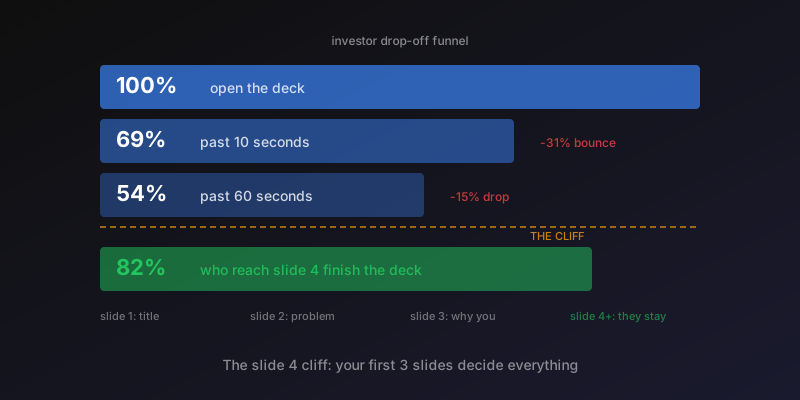
The data tells a clear story: 31% of investors bounce within 10 seconds of opening a deck. Another 15% leave within the first minute. But here's the number that matters: 82% of investors who reach slide 4 finish the entire deck.
That's the cliff. Your first three slides determine whether your deck gets a real read or a quick skim and a pass. Everything after slide 4 only matters if you survive the first three.
What happens in the first 10 seconds
When an investor opens your deck, they're not reading. They're scanning. DocSend's data shows the average time on a title slide is 3-5 seconds. In those seconds, the investor decides one thing: is this worth my time?
Your title slide needs to answer that question instantly. That means:
A one-liner that passes the clarity test. If someone reads it and still doesn't know what you do, you've already lost a third of your audience. "We're building the future of commerce" tells an investor nothing. "Stripe for B2B invoicing in Latin America" tells them exactly what you do, who it's for, and why it might be interesting. Read more about writing a one-liner that works.
Your name and stage. Investors are pattern-matching. They want to know if this is a pre-seed company or a Series B, because that changes how they evaluate everything else. Don't make them guess.
Nothing else. No team photos, no mission statements, no logos of companies that haven't actually partnered with you. The title slide is a filter, not a pitch. Its only job is to get the investor to slide 2.
The 60-second gate
If the investor makes it past the title, you have roughly 60 seconds before the next drop-off. That's slides 2 and 3. Together, these slides need to answer two questions: what problem are you solving, and why should I believe you can solve it?
Slide 2: the problem
This is where most decks start to fail. The typical problem slide is forgettable: a list of bullet points describing market pain that could apply to a hundred different startups. Investors have seen thousands of these. Generic problem statements don't create urgency.
What works instead:
- A specific scenario. "A logistics manager at a mid-size retailer spends 4 hours a day manually reconciling shipment data across 3 systems." That's concrete. The investor can picture the person, the pain, and the opportunity.
- A number that creates tension. "$2.3B is lost annually to invoice disputes in cross-border trade." Numbers ground the problem in reality. They give the investor something to anchor on.
- A before-and-after framing. Show the world as it is (broken, slow, expensive) and hint at the world as it could be. Don't solve the problem on this slide. Just make it feel urgent.
The problem slide should make the investor lean in. If they're still neutral after reading it, you'll lose them on the next slide.
Slide 3: why you
This is the slide that bridges problem to solution, and it's the one most founders get wrong. They jump straight to product screenshots or feature lists. But the investor hasn't bought the problem yet. They need one more reason to keep going.
Slide 3 should answer: why is your team the right one to solve this?
This isn't your full team slide. It's a single sentence or visual that establishes credibility. "Our founders spent 8 years building logistics software at Flexport" is enough. "We've already processed $12M in transactions during our beta" is enough. The investor needs just enough signal to think: these people might actually pull this off.
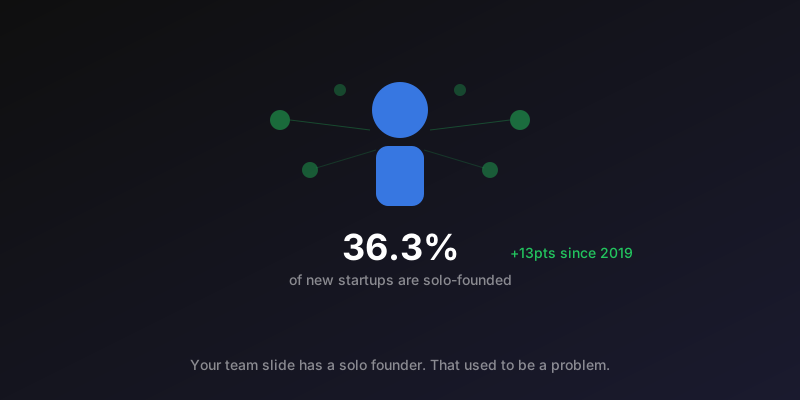
If you're a solo founder, that's fine. One-third of startups are solo-founded now. Focus on what you bring: domain expertise, technical depth, or early traction that proves you can execute alone.
The slide 4 threshold
Once an investor reaches slide 4, something shifts. They've invested roughly 60 seconds. They understand the problem. They have a reason to believe you. Now they're in evaluation mode rather than filtering mode.
This is where the slide order debate actually matters. Slide 4 is usually your solution or product slide. But its job isn't to be impressive. Its job is to confirm the promise of the first three slides.
What gets investors past the cliff:
- Visual clarity. A simple diagram or screenshot that shows how your product works. Not a feature matrix. Not an architecture diagram. A single image that makes the investor think "I get it."
- Connection to the problem. The solution should directly address the pain described on slide 2. If there's a disconnect, the investor will notice. "You said the problem was manual reconciliation, but your product slide shows a dashboard with 40 metrics" is a mismatch.
- Momentum. By slide 4, the narrative should feel like it's building. Problem, credibility, solution. Each slide adds a layer. If slide 4 feels like a restart or a tangent, the flow breaks.
The 82% completion rate after slide 4 tells you something important: investors who get this far are genuinely interested. They want to see your traction, your market size, your ask. Don't lose them with a confusing solution slide.
Common first-3-slide mistakes
These patterns kill decks before the investor reaches the solution:
Leading with the solution. Some founders put their product on slide 1 or 2 because they're excited about what they've built. But without context, a product screenshot means nothing. The investor doesn't know what problem it solves or why they should care. Problem first, always.
The "boiling the ocean" problem slide. "Healthcare is broken." "Education needs to change." "SMBs struggle with cash flow." These statements are true and completely useless. They're so broad that they don't create any tension. Narrow it down to a specific person with a specific problem.
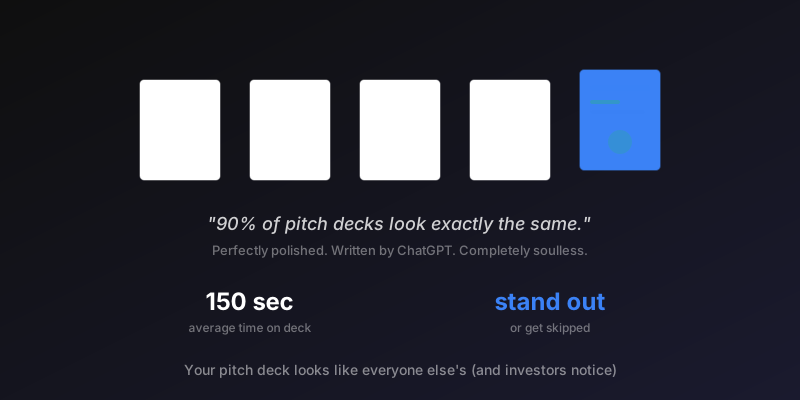
Too much text. Investors spend under 150 seconds on your entire deck. If your first three slides each have 100 words, you've burned most of that time before the investor has seen your product. Aim for 30 words or fewer per slide in the opening sequence.
No hierarchy. Every element on every slide should have a clear purpose. If the investor's eye doesn't know where to land first, they're processing instead of understanding. One message per slide. One visual focal point.
Missing the "why now." Timing is the hidden filter. If your problem has existed for 20 years and nobody has solved it, the investor wants to know what changed. A shift in regulation, a new technology, a market inflection. "Why now" can go on any of the first three slides, but it needs to be there somewhere.
What to put on each slide
Here's the framework that survives the cliff:
Slide 1: title
- Company name and logo
- One-liner (under 50 characters if possible)
- Stage and round size (optional but helpful)
- Contact info
Slide 2: problem
- One specific, vivid problem scenario
- A quantified pain point (dollars, time, frequency)
- The "why now" trigger if it fits naturally here
Slide 3: credibility bridge
- Why your team is uniquely positioned (one sentence)
- Early traction or validation (one number)
- Or: "why now" if it didn't fit on slide 2
Slide 4: solution
- What your product does (one sentence)
- How it works (one visual)
- Direct connection to the problem on slide 2
That's it. Four slides, each with one job. If each slide does its job, 82% of investors will see the rest of your deck. If your first three slides are unfocused, generic, or text-heavy, you'll lose nearly half your audience before they know what you've built.
The cliff is real. Design for it.
Enjoyed this article? Share it.