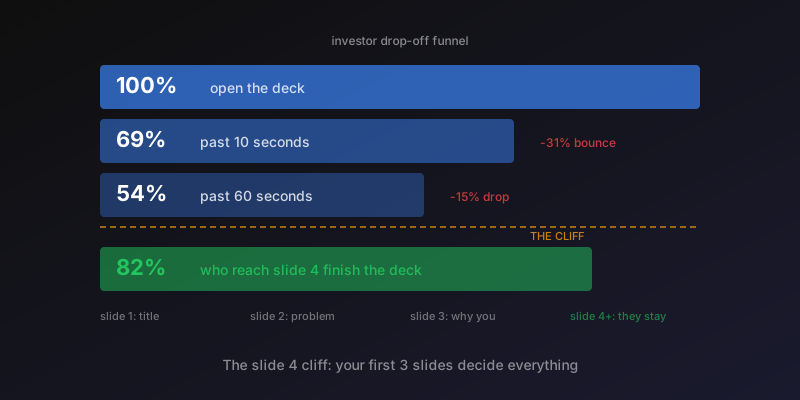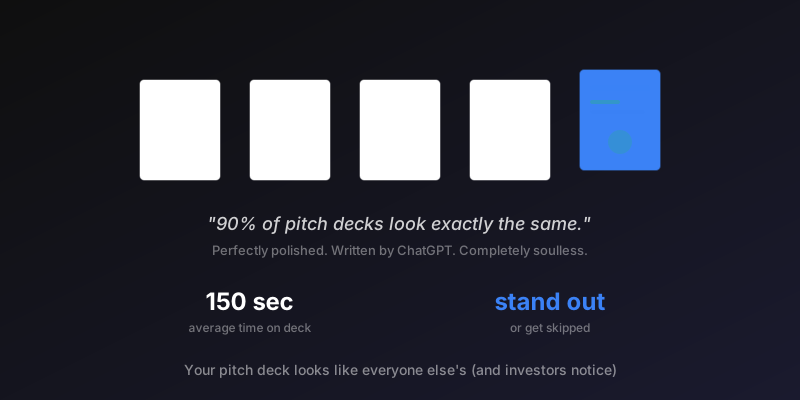
Investors now spend under 150 seconds reviewing a pitch deck before deciding whether to take a call. That number keeps dropping. Here's how to design your deck for the reality of investor attention.
The attention economy hit fundraising
A 2025 analysis found that the average time an investor spends on a new deck has dropped below 150 seconds. Only about 1% of decks sent to investors actually result in investment.
This isn't because investors are lazy. They're overwhelmed. A typical VC sees hundreds of decks per month. They've developed rapid filtering systems to surface what matters.
Your deck needs to work within this reality, not fight against it.
The single-message slide principle
The decks that perform best follow one rule: each slide delivers exactly one memorable message.
Not two points. Not a point with supporting context. One clear takeaway.
When an investor flips through your deck in 2 minutes, they should absorb 10-12 distinct ideas. If your slides are dense, they absorb nothing. If your slides are focused, they remember your story.
This means:
- Problem slide: One sentence about the pain, one visual or stat
- Solution slide: What you do, not how it works
- Traction slide: Your best metric, prominently displayed
- Market slide: One number with clear derivation
Cut everything else. Save the details for the call.
Mobile optimization matters now
According to recent pitch deck research, investors increasingly review decks on phones while commuting, between meetings, or late at night. Your deck needs to be readable on a 6-inch screen.
Test this yourself:
- Open your deck on your phone
- Can you read the text without zooming?
- Do your charts make sense at that size?
- Is the hierarchy clear?
If any answer is no, redesign. Large fonts, simple visuals, high contrast.
Live data is replacing static slides
A growing trend among well-funded startups: decks that link to live metrics dashboards.
Instead of a static "revenue chart updated Q3 2025," founders are embedding links to real-time data. This serves two purposes:
- It signals confidence in your trajectory
- It gives investors something current to reference
You don't need a fancy dashboard. A clean Notion page with weekly updates, or a simple metrics tracker, works. The point is showing you know your numbers and they're moving in the right direction.
What to prioritize in 150 seconds
If an investor only has 2.5 minutes, they'll see roughly 10 slides at 15 seconds each. Here's what matters:
Seconds 1-15 (title slide): Your one-liner and your best metric. If you have $50K MRR, put it here. If you have a recognizable logo customer, put it here.
Seconds 15-45 (problem + solution): Make the problem visceral. Make the solution obvious. Don't explain your technology.
Seconds 45-90 (traction + market): Your evidence that this works, and evidence that it matters at scale. VCs want proof, not promises. Every assertion should be backed with data.
Seconds 90-120 (team + ask): Why you specifically will win. What you need to get to the next milestone.
Seconds 120-150 (skim remaining slides): Business model, competition, timeline. These are supporting material now.
What investors skip
Research on deck engagement shows consistent patterns:
Product screenshots: Unless your UI is exceptional, investors skip these. They're evaluating the business, not the interface.
Detailed roadmaps: A slide with 47 features planned for the next 3 years doesn't help. Show your next milestone.
Long competitor matrices: A cluttered comparison chart suggests you're competing on features, not insight. One clear positioning statement beats a 15-competitor grid.
Generic "why now" slides: "AI is growing" and "remote work is here to stay" don't differentiate you. Unless your timing thesis is specific and defensible, cut this slide.
The 3-slide test
If an investor only remembered 3 slides, which would they be?
Design your deck so these three stand alone:
For pre-seed:
- One-liner + problem (what you're building and why it matters)
- Traction or validation (evidence this works)
- Team (why you'll win)
For seed and beyond:
- Traction (revenue, growth rate, unit economics)
- Market (TAM with bottom-up math)
- Ask (how much, for what milestones)
Run this test: show your deck to someone for 30 seconds. Ask them what they remember. If it's not these three points, restructure.
The goal isn't to explain everything
Your deck isn't meant to close the deal. It's meant to get a call.
Every slide should create curiosity, not satisfy it. Give investors enough to be interested, then stop. The details come in the meeting.
Practical adjustments:
- End slides with implicit questions (traction chart that shows growth, but doesn't explain the driver)
- Remove explanatory text that answers obvious follow-up questions
- Cut any slide that doesn't directly answer: "Why should I take this call?"
You have 150 seconds. Use them to open a conversation, not finish one.
Enjoyed this article? Share it.