The most common fundraising advice is also the most gatekeeping: "You need a warm intro."
It sounds reasonable. Investors get hundreds of cold emails a week. A mutual connection cuts through the noise. And yes, warm intros convert at higher rates. But the advice has calcified into dogma, and the data tells a more nuanced story than "cold outreach doesn't work."
What the data actually says
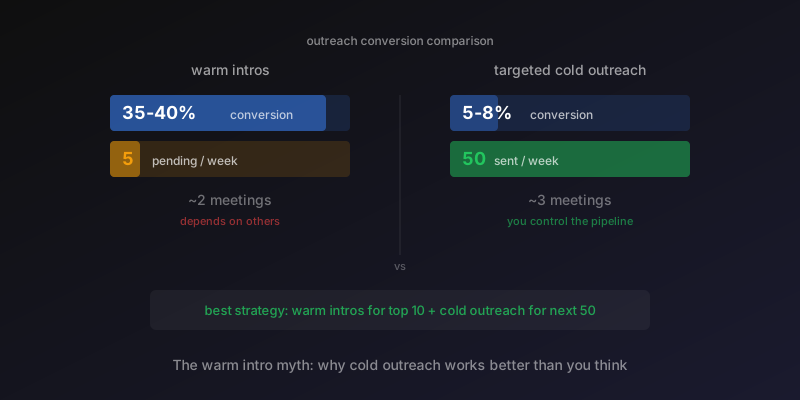
According to DocSend, warm intros lead to meetings roughly 35-40% of the time. Cold outreach converts at 1-3%. That gap looks damning until you consider volume.
A founder with 5 warm intro requests pending is waiting on other people's calendars, priorities, and willingness to spend social capital. A founder sending 50 targeted cold emails in the same week controls their own pipeline. At a 2% conversion rate, that's one meeting. At 3%, it's two. And those meetings came without burning favors or waiting three weeks for someone to "make the intro when the timing is right."
The math favors a blended approach. Warm intros for your top 10 targets. Cold outreach for the next 50.
Why warm intros fail more than people admit
The warm intro playbook assumes three things that are often wrong:
Your network overlaps with the right investors. If you're a first-time founder without a startup background, your LinkedIn connections probably don't include partners at the funds you're targeting. The advice to "just get a warm intro" ignores that network access is unevenly distributed by geography, background, and industry.
The introducer will pitch you well. Most intro emails are vague. "You should meet my friend, they're working on something cool in fintech." That's not a warm intro. That's a lukewarm mention. The investor reads it, files it, and forgets it. Unless your introducer genuinely understands your business and has credibility with that specific investor, the intro might actually hurt you.
The investor is actively looking. Warm intros work best when the investor has bandwidth and the intro comes from someone whose judgment they trust. If neither condition is met, you've spent social capital for the same outcome as a cold email: silence.
What actually makes cold outreach work
The 1-3% conversion rate is an average that includes terrible cold emails. Founders who send "Dear investor, we are disrupting the $500B market for..." deserve the 0% response rate they get.
Targeted cold outreach that demonstrates genuine research converts at 5-8% for pre-seed and seed founders. The difference comes down to four things:
Thesis alignment. If an investor's last three deals were in B2B SaaS for healthcare and you're building B2B SaaS for healthcare, say that. "I noticed you led rounds in Acme Health and Beta Care. We're solving a related problem in clinical trial recruitment." That's not cold. That's informed.
Stage match. Emailing a growth-stage fund about your pre-seed round wastes everyone's time. Check the fund's recent deals, not just their website copy. Many funds say "seed to Series A" but haven't done a seed deal in two years.
Specificity over flattery. "I've been following your work" is meaningless. "Your blog post on vertical SaaS metrics changed how we think about our unit economics" shows you've done homework. Better yet: "We hit the 150% net revenue retention benchmark you described in your Q3 LP letter." That gets a response.
A deck that survives the first 10 seconds. 31% of investors bounce within 10 seconds. If your cold email gets the click and your deck loses them on the title slide, the problem isn't the outreach. It's the deck.
The LinkedIn signal
Here's something most founders don't realize: investors are researching you before they respond. A cold email from a founder with a thoughtful LinkedIn presence, a few posts about their domain, and a clear company page converts significantly better than one from a founder with no visible footprint.
You don't need to be a LinkedIn influencer. Three things help:
- A clear headline. "CEO at Stealth" tells the investor nothing. "Building [specific thing] for [specific market]" tells them everything.
- A few posts showing domain expertise. Not fundraising content. Content about the problem you're solving. If you're building for logistics, write about logistics. Investors want founders who are obsessed with their market, not with fundraising.
- Social proof in context. Your about section should mention relevant experience, traction, or background. The investor will check.
The real advice
Stop treating warm intros as a prerequisite and start treating them as one channel in a multi-channel strategy.
For your top 10 targets: Pursue warm intros aggressively. Research the mutual connection. Write the intro email yourself so the introducer just has to forward it. Make it easy for them.
For your next 50 targets: Write personalized cold emails that demonstrate thesis fit, stage match, and genuine research. Use Pitchkit's investor outreach tools to identify the right investors and generate outreach that's specific to each fund.
For everyone: Build a visible presence before you start fundraising. Your LinkedIn profile, your company page, your deck. These are the assets that make both warm and cold outreach work.
The warm intro isn't dead. But the idea that you can't raise without one is holding back founders who have strong businesses and weak networks. The best outreach strategy is the one you control.
Enjoyed this article? Share it.