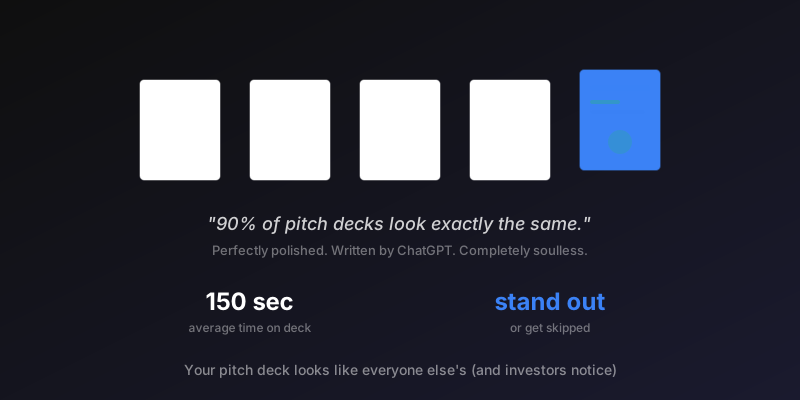
There is a strange irony happening in fundraising right now. Founders are using AI tools to write their pitch decks, and the result is that 90% of decks look exactly the same. Perfectly polished. Grammatically flawless. And completely soulless. Investors notice. They notice because they read hundreds of these decks every month, and the sameness has become its own red flag.
I say this as someone building an AI pitch tool. The problem is real, and pretending otherwise would be dishonest.
What "soulless" actually means
When investors describe a deck as soulless, they are not talking about design. They are talking about specificity. A soulless deck reads like it could belong to any company in the space. Swap the logo, change the company name, and the content still works. That is the tell.
Here are the patterns investors flag:
- Generic problem statements. "Small businesses struggle with X" instead of "We talked to 40 restaurant owners in Chicago and 37 of them track inventory on paper napkins."
- Template-perfect structure. Problem, solution, market, traction, team, ask. In that exact order. With that exact framing. Every single time.
- Buzzword density. Every sentence contains "AI-powered" or "data-driven" or "end-to-end." The words mean nothing without context.
- Missing founder voice. No opinions. No point of view. No moment where you can feel a real person behind the slides.
The story needs to land quickly. The business model needs to be understandable without a translator. When everything reads like a template, neither of those things happens.
The AI writing tells
Investors are getting good at spotting AI-generated content. Not because they run detector tools, but because patterns emerge when you read 50 decks a week.
Hedging language everywhere. AI models default to balanced, qualified statements. "This could potentially address a significant market opportunity." A founder who has spent two years on a problem does not write like that. They write with conviction.
Perfect paragraph structure. Every paragraph has a topic sentence, supporting evidence, and a concluding thought. Real pitch writing is messier. It has rhythm. Short sentences. Punchy claims followed by proof.
Absence of specific numbers. AI fills gaps with directional language. "Significant growth" instead of "312% MRR growth since January." "Large addressable market" instead of "$4.2B spent annually on manual compliance reviews in healthcare." Vague language signals that either the numbers do not exist or the founder did not write the deck.
Identical phrasing across decks. When investors see the same sentence structures appearing in multiple pitches, that is a dead giveaway. "Our proprietary technology enables..." appeared in four decks one partner received in a single week. All from different companies. All clearly from the same model.
What makes a deck memorable
The decks that get meetings share something specific: they contain at least one moment that could only come from this founder building this company.
Bad (AI-generated feel): "The healthcare scheduling market is fragmented and inefficient. Current solutions fail to address the needs of modern practices. Our platform provides a comprehensive solution that reduces scheduling friction."
Good (founder-written feel): "My mom runs a dental practice. She loses 11 hours a week to scheduling. I watched her miss my brother's baseball games because she was on the phone rebooking cancelled appointments. That is broken."
The second version is specific. It has a person in it. You can picture the situation. And critically, it answers the question investors are really asking: "Why will this specific team make me look like a genius for investing in them 5 years from now?"
Here is another contrast:
Bad: "We identified a gap in the market for AI-driven financial analysis tools for SMBs."
Good: "I was a CFO at three different startups. At every one, I built the same Excel model from scratch. The third time, I decided to build the product instead."
The good versions contain founder-market fit. They contain a reason to believe. No AI model can fabricate that because it requires lived experience.
The personal story advantage
Investors spend under 150 seconds on a deck before deciding whether to take a meeting. In that window, the thing that stops them from clicking away is recognition. Not recognition of the market or the product category, but recognition of authenticity.
Your specific insight is your competitive advantage in fundraising, not just in your market. The observation you made while working in the industry. The conversation with a customer that changed your approach. The failure that taught you something nobody else seems to know.
DocSend data shows the team slide is the most scrutinized slide in a pitch deck. Investors spend more time there than on your market size or your financial projections. They want to know who you are and why you are the right person for this problem.
AI cannot write your team slide for you. It can format it. It can suggest what to include. But the substance has to come from you.
How to use AI tools without losing your voice
Full disclosure: we build Pitchkit, which uses AI to help founders with their pitches. So this section is as much a note to ourselves as it is advice.
AI tools are good at:
- Structure. Suggesting which slides to include and in what order.
- Editing. Tightening sentences, cutting filler, improving clarity.
- Research. Pulling market data, finding comparable companies, identifying trends.
- First drafts. Getting past the blank page when you are stuck.
AI tools are bad at:
- Your story. The reason you started this company.
- Your insight. The non-obvious thing you know about this market.
- Your voice. The way you explain things that makes people lean in.
- Your numbers. The specific traction, metrics, and evidence from your business.
The honest approach: use AI to build the scaffolding, then replace every generic sentence with something only you could write. If a sentence could appear in a competitor's deck without anyone noticing, rewrite it.
A practical test. Read each slide out loud. Does it sound like you talking to a friend about your company? Or does it sound like a consultant's report? If it is the latter, the AI did too much of the work.
The goal is not to avoid AI tools. The goal is to make sure the final product sounds like a human who cares deeply about a specific problem, not like a language model that was asked to write a pitch deck.
The profitability shift
There is another reason generic AI-written decks are failing. The investor landscape has changed.
Analysis of 50 real startup pitch decks shows profitability logic appearing earlier in decks now. Not just growth-first storytelling, but clear explanations of unit economics and paths to profitability. Founders who rely on AI to generate their financial narrative often end up with the same "hockey stick growth" story that worked in 2021. Investors in 2026 want something different.
AI startups still command a 42% valuation premium, but investors have learned to see through what they call "AI veneer on old ideas." The premium goes to companies with genuine technical depth, not companies that added "AI-powered" to their tagline and let ChatGPT write their pitch.
What investors want to see now:
- Unit economics that work. Not projected unit economics in year three. Current numbers, even if they are small.
- Capital efficiency. How much revenue per dollar raised. How long until breakeven on a cohort basis.
- Specific AI advantage. If you claim AI is your moat, show the benchmark. Show the training data advantage. Show why this cannot be replicated by a competitor prompting the same foundation model.
- Honest financials. Projections grounded in current run rates and conversion data, not aspirational models.
A deck generated entirely by AI will default to optimistic, generic financial storytelling. It does not know your burn rate. It does not know your CAC payback period. It does not know that your best customer segment is mid-market healthcare companies in the midwest, not the enterprise accounts your TAM slide implies.
Make the deck yours
The pitch deck is not a document. It is an argument for why you, specifically, should be trusted with someone else's money to solve this particular problem. AI can help you make that argument clearer. It cannot make the argument for you.
Write the first draft yourself, even if it is rough. Use AI to refine it. Then go back and make sure every slide still sounds like you. Make sure the numbers are yours. Make sure the story is yours. Make sure an investor reading it would know, without seeing your name, that a real person wrote this about a real problem they care about.
That is the deck that gets the meeting.
Sources: The VC Corner, 50 real startup pitch decks | Crunchbase, 2026 VC predictions | DocSend, team slide data | Pitchkit, the 150-second pitch deck
Enjoyed this article? Share it.