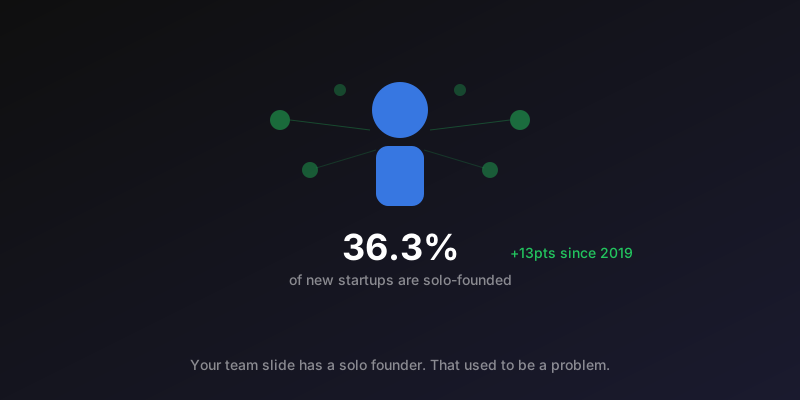
Over one-third of new startups are now solo-founded. Carta's data shows the share rose from 23.7% in 2019 to 36.3% in the first half of 2025. That's a 13-point shift in six years. Yet most pitch deck advice, most AI tools, and most investor checklists still assume you have a co-founder.
If you're a solo founder writing your team section, you've probably noticed. The guidance doesn't fit. The examples feature CEO/CTO duos. The scoring criteria ding you for "team structure." The checklist asks about complementary skills between founders you don't have.
We fixed this in Pitchkit. Here's why it matters, and how to write a team section that works as a solo founder.
The market has shifted
The traditional VC objection to solo founders was straightforward: startups are too hard for one person. You need a technical co-founder to build and a business co-founder to sell. The data supported this. YC famously preferred teams. Most accelerators did too.
That logic assumed a world where building software required a team. It doesn't anymore.
Vibe coding changed the math
Vibe coding, the practice of building software by describing what you want in natural language while AI handles the implementation, has compressed development timelines dramatically. The term was coined by AI pioneer Andrej Karpathy, and search interest has exploded over 6,700% in recent months.
What took a team of three several months in 2020 now takes one person a few weeks. Vibe coding, AI agents, no-code tools. A solo technical founder can ship a working product, get it in front of customers, and iterate faster than a two-person team still arguing about technical architecture.
The results are showing up in real outcomes. Israeli solo founder Maor Shlomo built Base44 entirely through vibe coding. In six months: 250,000 users, profitable by month three, eight employees total. Wix acquired it for $80 million cash. Not a decade-long journey. Six months from first line of AI-generated code to an eight-figure exit.
When Anthropic CEO Dario Amodei was asked when the first billion-dollar company with a single employee would appear, he said "2026" with 70-80% confidence. Sam Altman confirmed there's a CEO group chat betting on when it happens. This isn't a fringe idea. The people building the tools believe it.
Successful solo-founded companies like Midjourney, Polymarket, and Vercel have already demonstrated that the solo model can produce venture-scale outcomes. India's Emergent, a vibe-coding platform founded by Dunzo's co-founder, hit $50M ARR in seven months and raised $70M at a $300M valuation.
The 30 highest-valued solo startups of 2026 span fintech, AI infrastructure, developer tools, and consumer products. This isn't one lucky outlier. It's a pattern.
What investors actually worry about
The co-founder question was never really about having two names on a slide. It was about risk.
Investors worry about:
Single point of failure. If you get sick, burn out, or lose motivation, there's nobody to pick up the work.
Skill gaps. Can you build AND sell? Most people are strong at one, weak at the other.
Decision isolation. Solo founders don't have a co-founder to challenge bad ideas or provide emotional support during hard stretches.
These are real concerns. But they have solutions that don't require giving away 50% of your company. As one observer noted: "co-founder breakups kill more startups than almost any other factor." The risk of a bad co-founder is real too.
Your team section needs to address the underlying concerns directly, not apologize for being solo.
How to write it at each stage
The answer depends on where you are.
Angel and pre-seed
At angel stage, a solo founder with deep domain expertise and a shipped product is a strong signal. You understood the problem, built the solution, and got it in front of customers. That's exactly what angel investors want to see.
Your team section should emphasize:
Founder-market fit. Why you specifically understand this problem better than anyone. Years in the industry, personal experience with the pain, unique insight.
Execution speed. You built and launched in weeks, not months. If you used vibe coding or AI-assisted development, say so. It demonstrates that you can move fast with modern tools.
Support network. This is the key differentiator between a strong solo founder and a risky one. Name your advisors. List your mentors. If you have an advisory board, describe who's on it and what they bring.
The plan. Mention that you're actively looking for a co-founder or first key hire. Investors don't need you to have one yet. They need to know you're thinking about it.
Seed
At seed stage, the bar rises. You've had time to hire, find a co-founder, or build an advisory board. If you're still completely solo with no support network, investors will ask why.
The concern isn't philosophical. It's practical. Seed-stage companies need to scale. Scaling requires delegation. If you haven't started building beyond yourself, it raises questions about whether you can.
Your team section should show progress: first hires, a co-founder you've brought on, key advisors actively involved in the business. "Still looking for a co-founder" is weaker at seed than at angel. "Hired a head of sales and have 3 advisors" is much stronger.
Series A and beyond
At Series A, a solo founder without key hires is a genuine gap. The company should have leadership beyond the founder. This isn't bias against solo founders. It's the reality of scaling a company past initial traction.
Solo founder team section templates
Here are copy-and-adapt templates for each stage. Replace the brackets with your specifics.
Angel stage template
[Your name], solo founder. [N] years in [industry], where I [specific experience with the problem]. Built and launched [product] in [timeframe] using [tools/approach]. [Traction metric: waitlist, signups, LOIs, revenue].
Advisory board: [Name], [role/credential]; [Name], [role/credential].
Next hire: Actively recruiting [role] with [specific skill] background.
Example:
Sarah Chen, solo founder. 8 years in supply chain management at Flexport and Maersk. Built and launched RouteFix in 4 weeks using AI-assisted development. 200 waitlist signups, 3 signed LOIs.
Advisory board: James Park, former VP Ops at DHL (15 years logistics); Maria Santos, angel investor with 3 logistics exits.
Next hire: Actively recruiting a co-founder with enterprise sales background.
Pre-seed stage template
[Your name], founder. [Background]. Shipped [product] and acquired [early users/customers] as a solo founder in [timeframe].
Team: [First hire name and role, if applicable]. [N] contractors/part-time contributors.
Advisors: [Name], [credential] (advises on [area]); [Name], [credential].
Hiring plan: [Specific role] by [quarter], [specific role] by [quarter]. [Co-founder search status if active].
Example:
Dr. Alex Rivera, founder. 10 years in healthcare IT, previously led EHR integration at Kaiser Permanente. Built MVP in 6 weeks, 150 beta users across 12 clinics.
Team: Head of sales (started month 3), 2 contract engineers.
Advisors: Dr. Linda Wu, ex-CMO of Stanford Health (clinical validation); Raj Patel, 2x health tech founder (go-to-market).
Hiring plan: Senior engineer by Q2, customer success lead by Q3. Evaluating co-founder candidates with payer network experience.
Seed stage template
[Your name], CEO/founder. [What you've achieved with this company: revenue, customers, product milestones].
Team ([N] people): [Key hire], [role]; [Key hire], [role]. [N] engineers, [N] other.
Advisors: [Name], [active involvement]; [Name], [active involvement].
Next hires: [Role], [Role] to support [specific growth goal].
The vibe-coded product: a strength with one caveat
There's a specific scenario worth addressing: you're a solo technical founder who built the entire product yourself using vibe coding or AI-assisted development.
This is increasingly common. And it's a strength and a question mark at the same time.
The strength: You shipped fast. You proved the concept. You demonstrated that you can build with modern tools. Speed is one of the most important traits investors look for. Base44's trajectory, zero to $80M exit in six months, started exactly this way.
The question: If you built everything alone, who handles sales? Customer success? Fundraising while you're coding? Investors will want to see that you're either developing those skills yourself or have a plan to bring in someone who has them.
Don't hide the fact that you built it with AI tools. That's a feature, not a bug. The solopreneur economy now contributes $1.7 trillion to the US GDP, and much of that growth is driven by AI-powered solo builders. But pair it with evidence that the business side is covered: an advisor with sales experience, a plan for your first business hire, or early traction that proves you can sell too.
What Pitchkit changed
We updated how Pitchkit evaluates team sections across all stages.
At angel and pre-seed, our AI no longer penalizes you for being a solo founder. Instead, it evaluates what matters: founder-market fit, execution speed, advisory support, and co-founder pipeline. The checklist now includes "If solo founder: what is the advisory/co-founder pipeline?" so you get guidance that's actually relevant.
At seed, the system flags solo founder status as something to address, but frames it as a next step rather than a failure.
The examples and gold standards now include solo founder scenarios alongside co-founder teams. Because both paths can work, and your pitch tool shouldn't pretend otherwise.
The bottom line
The co-founder requirement was always a heuristic, not a rule. In 2026, it's an increasingly outdated one. One-third of new startups are solo-founded. Vibe coding has made it possible to ship real products alone. The exits prove it can work at scale.
If you're a solo founder, own it. Show your domain expertise, your execution speed, your support network, and your hiring plan. That's a stronger team section than a co-founder team with no relevant experience and no traction.
Sources: Carta Solo Founders Report 2025, Solo Founders in 2025, The rise of the one-person billion-dollar company, Base44 acquisition, Solopreneur boom 2026, Emergent raises $70M (TechCrunch), 30 highest-valued solo startups 2026
Enjoyed this article? Share it.