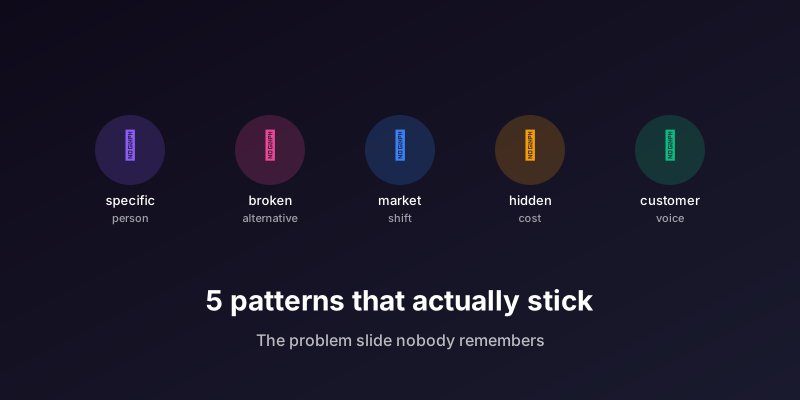
Most problem slides are forgettable. These 5 patterns actually stick with investors.
Why problem slides fail
The problem slide should be the easiest slide in your deck. You're describing pain that real people experience. Yet most problem slides are:
- Too abstract ("Organizations struggle with inefficiency")
- Too broad ("The healthcare system is broken")
- Too data-heavy (charts without story)
- Too obvious (problems everyone knows exist)
Investors see 50+ decks per week. They've heard every generic problem statement. Your job is to make them feel the problem differently.
Pattern 1: The specific person
Start with one person. One moment. One pain.
Instead of: "Small businesses struggle to manage their finances efficiently, leading to cash flow problems and administrative burden."
Try: "Sarah runs a 12-person design agency. Last Tuesday, she spent 4 hours reconciling invoices because her accountant uses one system, her clients use another, and her bank statements don't match either. She does this every week."
The specific is more believable than the general. Investors can picture Sarah. They can't picture "small businesses."
Pattern 2: The broken alternative
Show what people do today, and why it's terrible.
Instead of: "Current solutions are inadequate for modern needs."
Try: "Right now, sales teams track deals in spreadsheets. They copy-paste from email into their CRM. They forget to follow up. We surveyed 200 sales reps: the average rep spends 6 hours per week on data entry that doesn't close deals."
This pattern works because it:
- Names a specific alternative (spreadsheets, manual processes)
- Quantifies the pain (6 hours/week)
- Implies the solution without stating it
Pattern 3: The market shift
Something changed. The old solutions no longer work.
Instead of: "The market is evolving rapidly and legacy solutions can't keep up."
Try: "In 2020, 2% of medical consultations were virtual. In 2024, it's 34%. But scheduling software still assumes you're booking a room, not a video link. Clinics are using 3 different tools to do what should take one."
This pattern works for:
- Markets disrupted by technology changes
- Regulatory shifts
- Behavioral changes (post-COVID, generational shifts)
The key: be specific about what changed and when.
Pattern 4: The hidden cost
The problem isn't obvious. You're revealing something people don't realize.
Instead of: "Companies waste significant resources on inefficient processes."
Try: "Enterprise companies spend $4.2M per year on contract review. 73% of that time is spent on contracts that don't change. The expensive lawyers review the same standard clauses hundreds of times because no one's tracking what's already been approved."
This pattern positions you as the expert. You've done the research. You see something others don't.
Requirements for this pattern:
- A surprising stat (ideally from your own research)
- A clear explanation of why the cost is hidden
- Implicit urgency (this is a problem worth solving now)
Pattern 5: The voice of the customer
Let your customers make the argument for you.
Instead of: "Users are frustrated with existing tools and seeking better alternatives."
Try: "Here's what construction managers told us:
'I've tried 6 different project management tools. They're all designed for tech companies, not job sites.' - Mike, Project Manager, 15 years
'My team won't use software that requires WiFi. Half our sites don't have it.' - Dana, Operations Director
'I need something my subcontractors will actually open. They don't check email.' - James, General Contractor"
Direct quotes are powerful because:
- They're specific and emotional
- They reveal needs you might not articulate well
- They prove you've talked to customers
Combining patterns
The best problem slides often combine 2-3 patterns:
Example combining patterns 1, 2, and 4:
"Last month, I watched a hospital administrator named Jennifer spend her entire Friday downloading reports from 5 different systems, copying data into Excel, and manually building a compliance report. She does this every month.
Jennifer isn't unusual. We surveyed 50 hospital administrators. On average, they spend 23 hours per month on manual data aggregation. Time that could go to actual patient care.
The hidden cost: $847,000 per year in administrative salary spent on work a computer should do."
The test
Read your problem slide to someone outside your industry. Ask them:
- Can you describe the problem in your own words?
- Who has this problem?
- How painful is it (1-10)?
If they can't answer all three, your problem slide needs work.
What to avoid
- Stats without story. "The market is $50B" isn't a problem statement.
- Jargon. If you need to explain the terms, you've lost them.
- Solutions disguised as problems. "Companies lack an AI-powered platform for X" is a solution, not a problem.
- Problems only you care about. The problem should be obvious once you point it out.
Your problem slide is your chance to make investors care. Make it count.
Enjoyed this article? Share it.