AdviceJanuary 24, 2026
The VC response formula: what makes them reply in 48 hours
Why do some cold emails get responses while others disappear? The 4-part formula for investor outreach.

Mari Luukkainen
Founder
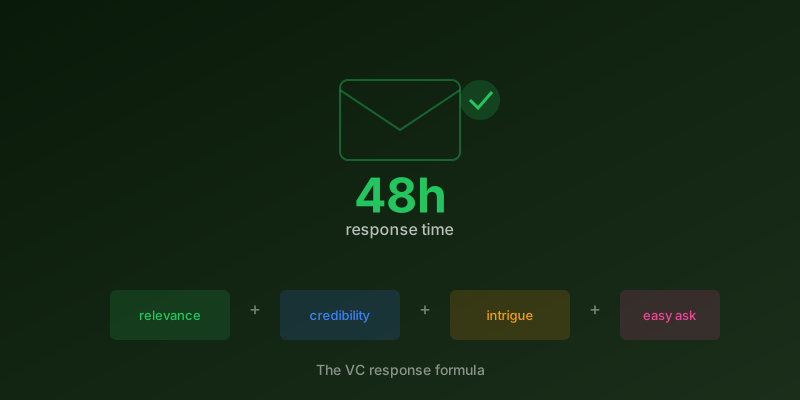
Why do some cold emails get responses while others disappear? The 4-part formula for investor outreach.
Mari Luukkainen
Founder
Why do some cold emails get responses in 48 hours while others disappear? Here's what the data shows.
Let's be honest: most cold outreach to VCs gets ignored. The response rate for generic pitch emails is under 5%. But highly targeted, well-crafted outreach can hit 25-40%.
The difference isn't luck. It's formula.
Investors decide whether to read your email based on the first line. That line needs to answer: "Why are you emailing me specifically?"
Generic (ignored): "I'm reaching out because you invest in B2B SaaS companies."
Targeted (read): "I saw your comment on Lenny's podcast about vertical SaaS for construction. We're building exactly that: scheduling software for general contractors."
The targeted version shows you did homework. You're not mass-emailing. You have a reason to contact this specific person.
Where to find relevance signals:
Within the first paragraph, give them a reason to believe you're worth their time. This isn't bragging. It's efficient communication.
Weak credibility: "I'm a passionate entrepreneur who's been working on this idea for 6 months."
Strong credibility: "I spent 8 years running operations at Procore, where I saw this problem every day. My co-founder built the ML systems at Stripe."
Credibility anchors that work:
Your email should create curiosity, not answer every question. Give them enough to want a conversation.
Too much information: "Our AI-powered platform uses proprietary NLP algorithms to analyze contract language and extract key terms, enabling legal teams to review documents 3x faster with 95% accuracy, saving enterprise customers an average of $450K per year..."
Right amount: "We help legal teams review contracts 3x faster. Our first 5 customers are paying $50K/year each. Happy to share how we're different from the 15 other contract AI tools out there."
The intrigue hook works because it:
Make it stupid easy to respond. The harder your ask, the lower your response rate.
High friction: "Would you have 30 minutes this week for a call? I've attached our full deck for your review. Let me know what times work and I'll send a calendar invite."
Low friction: "Worth a 15-minute call? I can share more on how we're approaching this differently."
No attachments. No scheduling complexity. Just a simple yes/no question.
The template:
Subject line: [Specific reference] + [What you do] Example: "Lenny's podcast + construction scheduling"
First line: Relevance signal "Caught your episode on vertical SaaS, specifically the part about underserved industries."
Second line: What you do + credibility "We're building scheduling software for general contractors. I ran ops at Procore for 8 years and kept seeing this gap."
Third line: Intrigue hook "We have 12 GCs paying $800/month after 4 months. The retention is unusual. Happy to explain why."
Ask: Simple question "Worth a quick call?"
Signature: Name, title, one-line company description "Sarah Chen, CEO @ BuildSync - Scheduling for construction crews"
Total length: 5-6 sentences. Under 100 words.
Don't attach your deck to cold emails. It screams "mass outreach" and often triggers spam filters. If they want the deck, they'll ask.
"Would you like to meet? Or if not, could you introduce me to someone else? Or maybe invest in our upcoming round?"
One email. One ask.
If your email requires scrolling on mobile, it's too long. VCs check email on phones. Respect that.
"I've been following your incredible career and am so impressed by your portfolio."
This reads as fake even when it's genuine. Skip it.
"We're going to be huge" means nothing. "We have $30K MRR" means something.
Best days: Tuesday, Wednesday, Thursday Best times: 7-9 AM or 4-6 PM (investor's timezone) Worst times: Friday afternoon, Monday morning, weekends
Why these times work: investors batch email processing. Early morning catches the first sweep. Late afternoon catches the end-of-day clear-out.
One follow-up is appropriate. More than two is spam.
Follow-up timing: 5-7 days after initial email
Follow-up content: Add new information, don't just "bump"
Bad follow-up: "Just wanted to bump this to the top of your inbox!"
Good follow-up: "Quick update: we closed 3 more customers since I emailed. Now at 15 paying GCs. Still interested in connecting?"
The good follow-up gives them a reason to respond now that they didn't have before.
Get all four right, and you'll hear back. Miss any one, and you're in the ignored pile.
Your email isn't the pitch. It's the request for a conversation where you'll give the pitch. Keep it short. Keep it relevant. Make it easy to say yes.
Enjoyed this article? Share it.
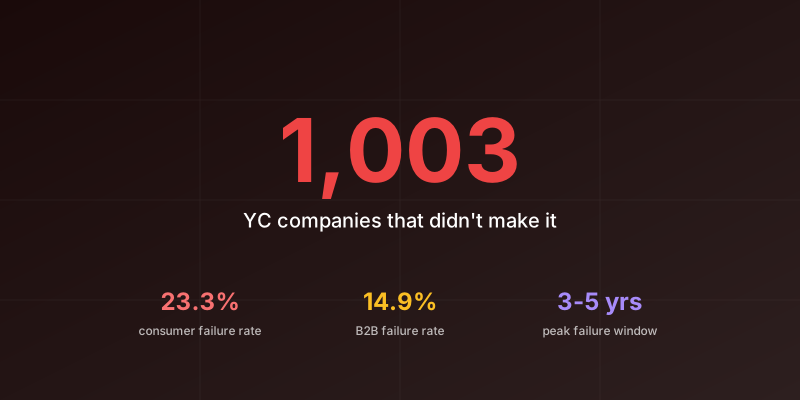
We analyzed the 1,003 YC companies that shut down. Industry patterns, one-liner differences, and when companies die.
 Mari Luukkainen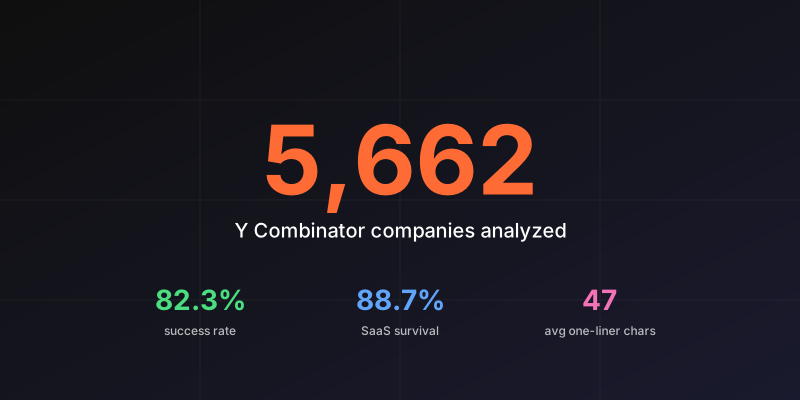
We analyzed 5,662 YC companies. 82.3% success rate, the rise of AI, and what top company one-liners have in common.
Mari Luukkainen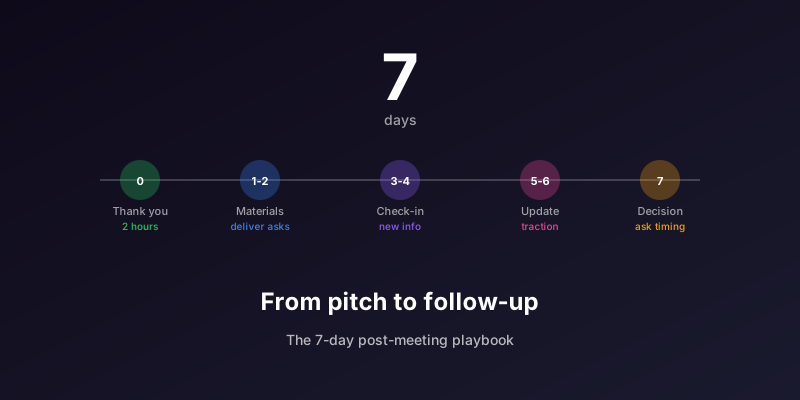
You had a great investor meeting. Now what? The day-by-day guide to following up without being annoying.
Mari Luukkainen