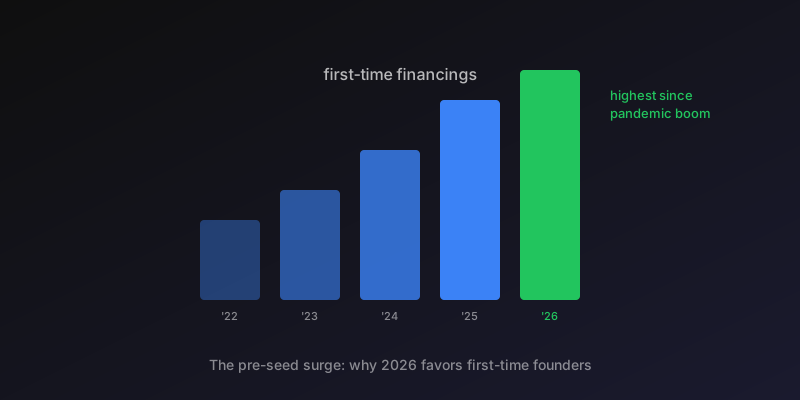
While later stages are concentrating capital into fewer winners, something different is happening at the earliest stages. 2025 had more "first-time financings" than seen in years, perhaps since the height of the pandemic boom. For first-time founders, this creates real opportunity.
The bifurcated market
The venture market has split into two distinct patterns:
Late stage (Series A and beyond): Fewer deals, larger checks, concentrated in proven winners. Series A deal volume dropped 18% year-over-year. Capital is flowing to fewer companies at higher valuations.
Early stage (pre-seed and angel): More deals, more investors, more experimentation. First-time financings have increased significantly. New founders are getting funded at rates not seen since 2021.
This creates an interesting dynamic. It's easier to get started, but harder to graduate to the next level. Plan accordingly.
Why early stage is heating up
Several factors explain the pre-seed surge:
Investors front-loading risk. According to Crunchbase, it could be "a great time to be an early-stage firm if you can pick well and get in before the big uptick rounds, which are increasingly happening at the A stage."
The logic: if the best companies are going to raise massive Series A rounds, investors want equity before valuations explode. Writing smaller checks earlier is a strategy to own a piece of the winners.
Lower cost to start. Building an MVP in 2026 costs a fraction of what it cost in 2015. AI coding tools, no-code platforms, and cloud infrastructure mean a small team can build meaningful products quickly. Investors can fund more experiments at lower cost.
Talent availability. Tech layoffs in 2023-2024 created a pool of experienced builders starting their own companies. Investors see opportunity in funding people with proven track records at places like Google, Meta, and successful startups.
What this means for first-time founders
The good news: you can likely get funding. The bar for pre-seed has lowered in terms of prior exits or credentials. Investors are willing to bet on potential.
The adjustment: check sizes are smaller, and expectations for efficiency are higher. Funding amounts at the earliest stages have slightly dropped as investors demand higher efficiency.
Typical pre-seed rounds in 2026:
- Range: $250K-$750K
- Post-money valuation: $3M-$6M typical
- Higher valuations ($8M+): Require exceptional team or early traction
You can get funded with less than you'd expect: a clear problem, a credible team, and a working prototype. You don't need revenue. You don't need a prior exit. You need conviction and competence.
The efficiency mandate starts early
Even at pre-seed, investors now think about capital efficiency. The days of raising $1M to "figure it out" are over.
What investors expect from pre-seed companies:
Clear milestones. What will you accomplish with this money? Be specific. "$500K gets us to 50 paying customers and validates pricing" is better than "$500K gives us 12 months to find product-market fit."
Tight burn rate. Pre-seed companies should run lean. A 3-person team spending $40K/month is reasonable. A 3-person team spending $100K/month raises questions.
Thoughtful hiring plan. Investors want to see you'll use their money to reach milestones, not just to hire fast. "We'll hire a full engineering team" is less compelling than "We'll hire one senior engineer to ship the core product."
How to position as a first-time founder
The repeat founder advantage is real. Investors statistically prefer founders with prior exits. But you can compensate.
Domain expertise. Did you spend 5 years in the industry you're disrupting? That matters. Deep knowledge of the problem can outweigh startup experience.
Technical credibility. Can you build the product yourself? First-time technical founders have an advantage. You don't need to hire an engineering team or convince a CTO to join.
Early traction. Nothing beats proof. If you've built something that users love, your background matters less. Show retention curves, engagement metrics, or revenue.
Unfair insight. What do you know that others don't? Maybe you saw a problem firsthand in your previous job. Maybe you have access to a unique distribution channel. Specific advantages beat general credentials.
The pre-seed to seed bridge
The challenge: you raised pre-seed. Now you need to bridge to seed, then eventually Series A.
Pre-seed to seed is often overlooked. The typical path:
Pre-seed milestone: Build MVP, get initial users, validate problem-solution fit Seed milestone: Achieve early revenue, demonstrate product-market fit signals, prove the business model
If your pre-seed is $500K and your burn is $50K/month, you have 10 months. That's tight. You need to move fast to hit seed milestones.
Recommendations:
- Raise enough pre-seed to have 12-15 months runway
- Set aggressive but achievable 9-month milestones
- Leave 3-6 months for the seed raise process
The opportunity for scrappy teams
The current market favors founders who can do more with less.
Stories that resonate:
- "We built our MVP in 3 months with a team of 2"
- "We got to 100 users before raising any money"
- "We validated demand through a waitlist before writing code"
Stories that don't:
- "We raised money to explore the space"
- "We'll hire to figure out product-market fit"
- "The market is huge and we'll capture some of it"
Investors are funding more pre-seed companies than ever, but they're being selective about which ones. They want to see you can build something real without a large team or a large budget.
Making the most of the surge
If you're a first-time founder in 2026, the environment is favorable at the earliest stages. Capital is available. Investors are looking.
To take advantage:
Move fast. The window for pre-seed generosity may not last. Raise now while conditions are good.
Raise enough. Don't underfund your company to minimize dilution. Getting to seed requires runway.
Build for efficiency. Start tracking burn multiple and CAC from day one. When you raise seed, these metrics will matter.
Plan for the long gap. Remember that Series A takes 616 days on average. Your seed round needs to bridge that gap.
The pre-seed surge is real. More first-time founders are getting funded than in years. But the path from pre-seed to Series A is harder than ever. Get in while conditions are good, then build a company that can survive the journey.
Enjoyed this article? Share it.