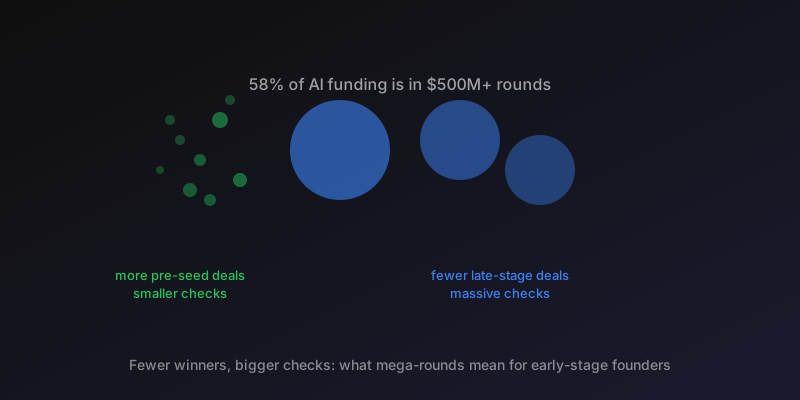
The venture capital market has split in two. At the top, a small number of companies are raising rounds so large they would have been unthinkable five years ago. Waymo closed a $16 billion round. AI startups now attract 33% of all VC funding, with 58% of that flowing into mega-rounds of $500 million or more. Meanwhile, the middle is getting squeezed. Series A deal volume is shrinking. Family offices are pulling back. And most founders are feeling the pressure without understanding why.
This is not a temporary correction. The structure of venture capital is changing. If you understand the new shape of the market, you can position yourself to benefit from it. If you don't, you'll spend months chasing funding that isn't coming.
How concentrated has capital become?
The headline number sounds healthy. Global VC deployment is up roughly 10% year over year. Startups on Carta raised $89 billion in 2024, up 18.4% from 2023. More money is flowing into startups than at any point since the 2021 peak.
But the distribution tells a different story.
That growth is concentrated in fewer, larger deals. A handful of AI companies are absorbing enormous amounts of capital. Waymo's $16 billion round alone accounts for a meaningful chunk of total deployment. When you strip out the mega-rounds, the picture for most startups looks flat or declining.
Here is what the concentration looks like in practice:
- AI captures a third of all VC funding. One sector, one-third of all dollars. If you're building outside of AI, the pool you're competing for is significantly smaller than the top-line numbers suggest.
- Mega-rounds dominate AI funding. 58% of AI venture dollars go into rounds of $500 million or more. The median AI startup is not seeing this money. A tiny number of companies at the top are.
- Family offices are retreating. Smaller bets from family offices dropped 32%. These were meaningful sources of seed and pre-seed capital. Their pullback makes early rounds harder for founders who relied on non-institutional money.
- Series A is contracting. Deal volume at Series A dropped 18% year over year. Fewer companies are graduating from seed. The bar is higher, and the number of available slots is lower.
The math is simple. More money, fewer recipients. If you're not in the small group of companies attracting outsized rounds, you're competing for a shrinking share of the rest.
Why this actually helps pre-seed founders
This sounds bleak, but the concentration at the top is creating a specific opportunity at the bottom. Here is the logic.
Investors know that the winners at Series A and beyond will raise massive rounds at high valuations. They've seen the pattern: a company raises a $3 million seed, then a $30 million Series A, then a $200 million Series B. The valuation jumps between stages are enormous.
So what do smart investors do? They try to get in earlier, before the prices go up.
According to Crunchbase, VCs want to "get in before the big uptick rounds at the A stage." This is driving more activity at pre-seed and seed. Investors are front-loading their risk, writing smaller checks earlier in the hope of owning a piece of the next company that breaks out.
The result: 2025 and early 2026 have seen more pre-seed first-time financings than at any point since the pandemic. More new founders are getting funded. More new funds are being raised specifically for pre-seed investing.
This is not charity. Investors are making a calculated bet. If the top of the funnel is going to produce a few massive winners, they want to own as many lottery tickets as possible. Your job is to look like a ticket worth buying.
Three things are working in your favor at the earliest stages:
Lower cost to start. Building an MVP costs a fraction of what it did even three years ago. AI coding tools, cloud infrastructure, and open-source frameworks mean a small team can build a real product on a small budget. Investors can fund more experiments for less money.
More investors at pre-seed. New micro-funds, angel syndicates, and solo GPs are entering the market specifically to invest at pre-seed. The number of people who can write you a $100K to $500K check has grown.
Talent availability. The tech layoffs of 2023 and 2024 created a wave of experienced builders starting their own companies. Investors see opportunity in funding people who built products at scale and now want to build for themselves.
The Series A squeeze
Here is where the good news ends and the planning needs to start.
Getting a pre-seed round is easier than it has been in years. Getting a Series A is harder than it has been in a decade. The gap between these two realities is where most startups die.
Series A deal volume dropped 18%. Less than 40% of seed-funded startups make it to Series A. The average time from seed to Series A has stretched past 600 days. These numbers define the reality you need to plan for.
Why is Series A so tight? Because of the same concentration dynamic that's creating mega-rounds at the top.
Series A investors have fewer slots and higher expectations. They know that the companies they fund at Series A will need to compete for Series B capital against the mega-round companies. So they're only backing startups that show clear evidence of breaking out.
What used to get you a Series A, say, $1 million ARR with decent growth, is now table stakes. Investors want to see $2 million or more in ARR, strong unit economics, clear market positioning, and a path to being one of the category winners. "Good enough" companies that would have raised a $10 million Series A in 2021 are struggling to close a $5 million round today.
This creates a specific danger for pre-seed founders. You can raise your first round relatively easily, feel momentum, and then hit a wall 12 to 18 months later when the Series A market doesn't materialize the way you expected.
What this means for your pitch
Your pitch needs to do something specific in this market: prove you can be one of the winners.
Investors are not looking for "solid" companies. They're looking for companies that have a realistic shot at capturing a large share of a meaningful market. The concentration of capital at the top means investors are making fewer, larger bets. Every investment needs the potential to return the fund.
This changes what belongs in your deck.
Market size matters more. In a market where capital concentrates in winners, investors need to believe your market is large enough to produce a winner. A niche $500 million TAM might have worked when VCs were making 30 bets per fund. It won't work when they're making 15.
Competitive positioning is critical. If capital is concentrating in fewer companies per category, investors need to understand why you'll be one of them. "We're better" is not enough. You need a structural advantage: proprietary data, unique distribution, a technical moat, or a wedge into the market that others can't replicate.
Capital efficiency signals survivability. In a market where Series A is uncertain, investors want to know you can survive long enough to earn it. Show that your burn rate is controlled. Show that each dollar of spend generates measurable progress. Founders who can do more with less are more attractive when the next round is not guaranteed.
The narrative needs to be about winning, not surviving. Don't pitch "we'll build a nice business." Pitch "we'll own this category." Investors in a concentrated market need to believe in upside, not just viability.
How to position for the concentration game
Here is the practical playbook for founders raising in this environment.
Plan for 24 months between rounds
If the average seed-to-Series-A timeline is over 600 days, plan accordingly. Raise enough at pre-seed or seed to give yourself at least 18 months of runway, ideally 24. Don't assume you'll raise your next round in 6 months. You probably won't.
This means raising slightly more than you think you need, or spending significantly less. Both work. Running out of money 14 months in, with Series A metrics still 6 months away, is how most startups fail in this market.
Define your Series A milestones on day one
Before you spend a dollar of your pre-seed raise, write down what a Series A investor will need to see. Work backward from there.
Typical Series A benchmarks in 2026:
- $1.5 million to $2.5 million in ARR (for SaaS)
- Three or more consecutive quarters of growth
- Net revenue retention above 110%
- Clear path to positive unit economics
- Evidence that growth is repeatable, not one-off
If you can't map your current plan to hitting those numbers within your runway, adjust the plan now. Not later.
Pick a market where you can be number one or two
The concentration of capital means investors are backing category leaders, not category participants. If you're entering a space with five well-funded competitors, you need a clear story about why you'll win.
Better yet, define a category where you can be the obvious leader. This doesn't mean inventing a fake category. It means finding a specific slice of a large market where you have a genuine advantage and can own the conversation.
Build proof, not promises
Pre-seed investors will fund a compelling vision. Series A investors will not. The gap between these two stages is the gap between promises and proof.
Start generating evidence immediately. Customer interviews, pilot programs, waitlists with conversion data, revenue from the first 10 customers. Anything that demonstrates real demand, not hypothetical demand.
The founders who struggle at Series A are the ones who spent their seed round building product in isolation and show up with a finished product but no market evidence. Build and sell simultaneously.
Use the AI narrative carefully
AI commands attention and capital. If your product genuinely uses AI in a meaningful way, make that clear. But be specific. "We use AI" means nothing. "Our model reduces underwriting time from 3 days to 4 hours by analyzing 200+ data points that human reviewers miss" means everything.
If AI is not central to your product, don't force it. Investors have seen enough "AI-powered" pitch decks to be skeptical. A company with real traction and no AI story will raise more easily than an "AI company" with no traction.
Know your investor's math
Every VC fund has a return model. They need their winners to return 10 to 100 times the investment. In a concentrated market, they're looking for fewer, bigger outcomes.
When you pitch, help the investor do the math. "Our market is $5 billion. We believe we can capture 5% in 7 years. At a 10x revenue multiple, that's a $2.5 billion outcome." This kind of framing, grounded in realistic numbers, helps investors see how you fit into their portfolio math.
Don't be afraid to address the concentration trend directly. "We know capital is consolidating in this space. Here's why we'll be one of the two or three companies that capture it." Investors respect founders who understand the market they're fundraising in, not just the market they're building for.
The venture market has always had winners and losers. What's changed is the margin between them. The winners are getting bigger checks than ever. Everyone else is fighting for scraps. Your job as an early-stage founder is to build a company that looks like a future winner, even when you're still small. That starts with understanding the game you're playing, and adjusting your strategy to match.
Sources: Qubit Capital: AI startup fundraising trends, Harvard Law: Venture capital outlook for 2026, Crunchbase: VC predictions for 2026, VC Trends February 2026
Enjoyed this article? Share it.