You are raising a seed round. You are not thinking about IPOs. That makes sense. Your company is pre-revenue, or barely post-revenue, and the idea of going public feels like it belongs to a different universe.
But your investors are thinking about IPOs. And that changes everything about how they evaluate your company right now.
The IPO window is reopening in 2026. That single fact reshapes investor psychology, fund economics, and the way VCs evaluate early-stage deals. Understanding why will make you a better fundraiser.
The IPO landscape right now
Let's start with what's actually happening.
Crunchbase predicts 15 companies could go public in 2026. That number sounds small, but after years of near-zero IPO activity, it represents a meaningful shift. Late-stage fintechs are chasing liquidity through public debuts. Waymo raised $16B at a $126B valuation in February 2026, signaling that the market can still support massive outcomes.
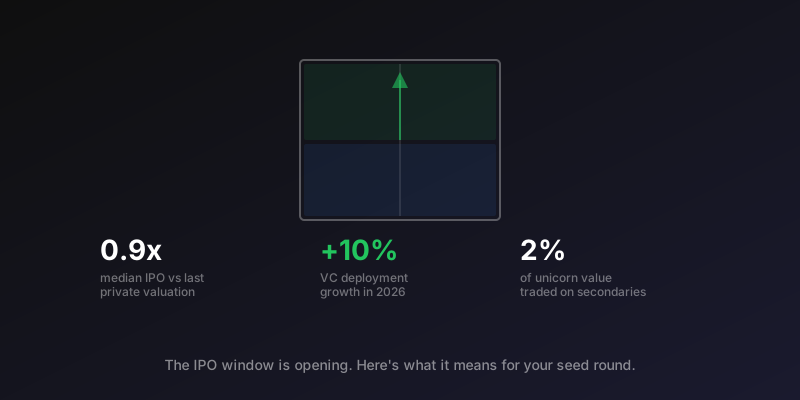
But the bar is high. According to Harvard's venture capital outlook, companies now need roughly $500M or more in revenue, 30%+ growth, and a positive Rule of 40 score to go public successfully. Two-thirds of unicorn IPOs priced below their last private valuation, with a median IPO-to-last-VC-valuation ratio of just 0.9x.
Read that again. Most companies that went public were worth less on the public market than their last private round suggested. That's the hangover from inflated 2021 valuations, and it's directly relevant to how investors are thinking about new deals today.
How IPOs affect your seed round
Here's the part most founders miss. VC is a cascade. Money flows in a cycle: LPs invest in funds, funds invest in startups, startups grow, exits return capital to LPs. When exits dry up, the entire cycle slows down.
For the past few years, exits were essentially frozen. VCs couldn't return capital to their LPs. That made LPs cautious about committing to new funds. And that made VCs cautious about deploying into new companies.
Now exits are starting to flow again. Global VC deployment is expected to increase 10% in 2026. That's not a boom, but it's the first sustained increase in years. More importantly, the mood is shifting. VCs are building what Harvard's outlook calls a "more complete liquidity toolkit," combining M&A, secondaries, and IPOs to create multiple paths to returns.
This matters for your seed round in three concrete ways.
More capital is available. When VCs can show LPs that exits are happening, LPs commit more capital. More committed capital means more deployed capital. The pie is growing, and some of that growth reaches early-stage rounds.
Investors are more willing to take risk. When exits feel possible, investors get more comfortable writing checks into early-stage companies. The logic is simple: if the path from seed to exit feels plausible, the risk-reward math improves. When exits are frozen, even great companies feel like traps.
Your competition for capital is also growing. More available capital attracts more founders. The window opening doesn't just benefit you. It benefits everyone raising at the same time.
Your investors are thinking about exit paths again
Here's what's changed in the room when you pitch.
During the exit drought, investors evaluated seed-stage companies almost entirely on the next round. The question was: "Can this company raise a Series A?" That's a short-term, lower-ambition question. It led to conservative bets on companies with clear near-term traction.
Now, with exits reopening, investors are expanding their aperture. They're asking: "What does this company look like at scale? What's the exit path?"
This doesn't mean you need an IPO strategy in your seed deck. That would be absurd. But it does mean that investors are paying more attention to:
Market size narratives. If your TAM is $500M, the math doesn't work for a venture-scale outcome. If your TAM is $10B, investors can sketch the path from seed to a meaningful exit. The IPO bar of $500M+ in revenue means your market needs to be large enough to support that kind of company.
Business model quality. Recurring revenue. Gross margins above 70%. Net dollar retention above 120%. These metrics matter at every stage, but they matter more when investors are thinking about public-market-ready businesses. Companies that IPO need to show the kind of unit economics that public market investors demand.
Category leadership potential. The companies going public are category leaders. When an investor evaluates your seed-stage company, they're now more actively asking whether you can dominate your category. "One of many" doesn't lead to IPOs. "The clear leader in X" does.
The secondaries angle
There's another shift happening that's less visible but equally important.
Only about 2% of unicorn market value trades on secondary markets today. That number is growing. Secondary markets are maturing, giving VCs and early employees more options for partial liquidity before a full exit.
Why does this matter for your seed round?
It changes the holding period calculation. Traditionally, seed investors expected to wait 7-10 years for any return. Now, with secondaries expanding and IPOs reopening, the path to liquidity is shorter and more varied. An investor in your seed round might get partial liquidity through secondaries at Series B or C, long before any IPO happens.
This makes seed-stage investing more attractive on the margins. Faster potential liquidity means lower effective risk, which means more willingness to invest.
It also means your cap table story matters more. Investors want to know that your equity structure is clean and that secondary transactions won't create problems. If your cap table is messy, with too many small holders or unclear terms, it becomes harder for downstream investors or secondary buyers to transact. Keep it clean from day one.
What this means for your pitch
Let's get practical. Here are the specific things you should adjust.
Your ask slide
Frame your raise amount in the context of milestones that demonstrate venture-scale potential. Don't just say "raising $2M to get to product-market fit." Say "raising $2M to reach $1M ARR and prove the unit economics that set up a $10M Series A."
Investors are thinking in longer arcs now. Show them you are too. Your ask slide should connect the current round to the trajectory, not just the next 18 months.
Your market slide
The IPO bar of $500M+ in revenue means investors are doing quick math. If your addressable market is $2B, they know a $500M revenue company would need 25% market share. That's hard. If your market is $20B, the math gets much more comfortable.
This doesn't mean you should inflate your TAM. Investors see through that instantly. It means you should be thoughtful about how you define your market. Bottom-up TAM calculations that show realistic paths to large revenue numbers are more convincing than top-down "the global X market is $50B" claims.
Your financial projections
Even at seed stage, show that you understand what venture-scale economics look like. Your five-year projection doesn't need to be accurate, but it should demonstrate that you understand the relationship between growth rate, margins, and burn.
Specifically, reference the Rule of 40. If your projections show a company growing 50% year-over-year with negative 30% margins, that's a Rule of 40 score of 20. That's below the IPO bar. It's fine for a seed-stage company, but your projections should show a path to improvement. Investors want to see that you'll eventually get there, even if "eventually" is five or six years out.
Your competitive positioning
With more companies heading toward public markets, category dynamics matter. Show that you're building toward a leadership position, not just competing. This means being clear about your wedge, your expansion strategy, and why you win against alternatives.
Your exit slide (if you include one)
Most seed decks don't have an exit slide, and that's usually fine. But if you do include one, update your thinking. Instead of "we'll get acquired by Google," acknowledge the changing landscape. Multiple exit paths (strategic acquisition, growth equity, public markets) show sophistication. You don't need to commit to any single path. Just show that you understand the options exist and that your business model supports them.
The bigger picture
The IPO window reopening is good news for founders at every stage. It restores the venture ecosystem's fundamental economics: money goes in, companies grow, exits happen, money comes back.
But "good news" doesn't mean "easy." The bar for exits is higher than it was in 2021. Companies need real revenue, real margins, and real growth. That standard filters all the way down to seed stage. Investors aren't just asking if you can get traction. They're asking if you can build the kind of company that survives long enough and grows fast enough to reach an exit.
Your job at seed stage hasn't changed. Build something people want. Find product-market fit. Grow efficiently. But the context around you has changed. Investors have more capital, more appetite for risk, and more mental models for how your company might eventually generate returns.
Use that to your advantage. Show them the big picture. Connect your seed-stage milestones to the long-term trajectory. Demonstrate that you understand the economics of venture-scale outcomes.
The IPO window opening doesn't change what you build. It changes how you talk about it.
Sources:
Enjoyed this article? Share it.