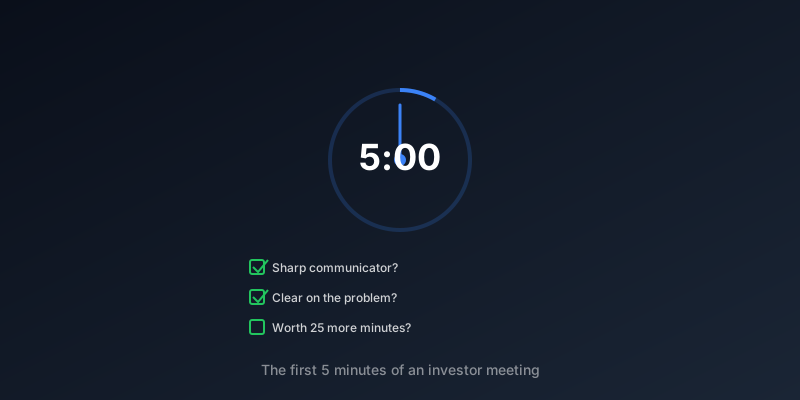
The first 5 minutes of an investor meeting determine whether you get the next 25. Here's how to use them.
What investors do in the first 5 minutes
Before you've said a word about your company, investors are calibrating. They're asking themselves:
- Is this person sharp?
- Do they communicate clearly?
- Would I want to work with them for 10 years?
This happens fast. By the time you finish your intro, they've already formed an impression that's hard to change.
The opening question
Most meetings start with some version of: "So, tell me about what you're building."
This is a test. They want to see if you can explain your company in 30 seconds without jargon, without rambling, and without needing slides.
Bad answer: "So we're building an AI-powered platform that leverages machine learning to optimize enterprise workflows through intelligent automation and predictive analytics..."
Good answer: "We help sales teams write follow-up emails. Our AI drafts the email, the rep edits it, and they send 3x more follow-ups. We have 40 paying customers."
The good answer tells them: what you do, for whom, proof it works. In three sentences.
Control the frame
The first 5 minutes set the frame for the entire meeting. If you let the investor drive, they'll ask whatever comes to mind. You'll bounce between topics. You'll never build momentum.
Instead, ask a framing question early:
"Before I dive in, is there anything specific you'd like me to focus on? Or should I walk you through the full story?"
This does two things:
- It shows you're prepared and confident
- It lets them tell you what they care about
If they say "give me the full pitch," you're in control. If they say "I'm really curious about your go-to-market," you know where to spend your time.
The credibility drop
Somewhere in the first 2 minutes, you need to establish why you're the right person to build this. Don't be awkward about it. Just state it.
"I spent 8 years at Salesforce running their SMB sales team. I saw this problem every day."
"My co-founder built the recommendation engine at Spotify. We know how to do this at scale."
"I've been a construction project manager for 12 years. I lived this problem."
One sentence. Then move on. You're not bragging. You're answering the question they're already asking in their head.
What not to do
Don't start with your deck. If you immediately share your screen and start clicking through slides, you've lost the chance to connect as a person. Have a conversation first.
Don't apologize. "Sorry, I'm a bit nervous" or "Sorry if this is too long" signals weakness. Just start.
Don't oversell. "This is the biggest opportunity I've ever seen" makes investors skeptical. Let the facts speak.
Don't rush. Speaking fast makes you seem anxious. Slow down. Pause. Let your words land.
The energy check
Investors invest in people, not just ideas. In the first 5 minutes, they're reading your energy.
They want to see:
- Confidence without arrogance
- Passion without delusion
- Clarity without oversimplification
They don't want to see:
- Defensiveness
- Desperation
- Confusion about your own business
If you seem unsure about what you're building, why would they bet money on it?
The transition to your pitch
After the initial conversation (usually 3-5 minutes), transition cleanly to your pitch.
"Want me to walk you through the deck? I'll keep it tight."
Or if you're not using slides:
"Let me give you the quick version, then we can dig into whatever's interesting."
This signals you respect their time and you're organized.
The investor's mental checklist
By minute 5, the investor is already checking boxes:
- Can this person communicate?
- Do they understand their market?
- Is there something here?
- Do I want to spend the next 25 minutes on this?
Your job in the first 5 minutes is to get enough checks that they lean in for the rest.
Practice this part
Most founders practice their pitch. Few practice the first 5 minutes.
Run through it with someone. Have them ask "So what are you building?" and see if you can answer in 30 seconds. Have them throw curveball questions and practice staying calm.
The first 5 minutes are when investors decide if you're worth their attention. Make them count.
Enjoyed this article? Share it.