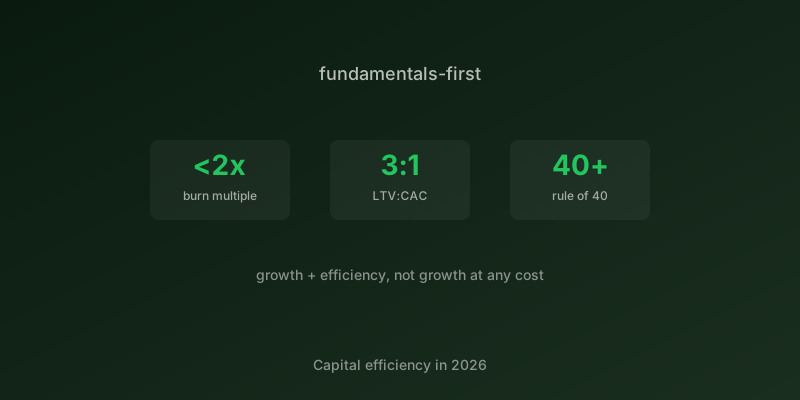
After two years of capital scarcity, liquidity is returning to venture. Global VC deployment is expected to increase 10% in 2026. But the rules have changed. Investors now filter for capital efficiency before they look at growth.
What does "fundamentals-first" actually mean for your pitch?
The new investor mindset
VCs surveyed by Crunchbase predict 2026 will reward "revenue growth, efficiency, and real AI advantage" while punishing "anything that is AI veneer on old ideas" and growth-at-any-cost strategies.
This represents a lasting shift, not a temporary mood. The 2021-era playbook of prioritizing growth over profitability is over. Even with more capital available, investors have learned that unsustainable growth creates unsustainable companies.
What this means in practice: your deck needs to prove you can build a profitable business, not just a growing one.
Metrics that matter in 2026
Burn multiple
Burn multiple = Net burn / Net new ARR
This measures how much you spend to generate each dollar of new revenue.
- Below 1x: Exceptional efficiency
- 1-2x: Good for growth-stage
- Above 2x: Concerning for most investors
If you're burning $200K/month and adding $100K in new ARR, your burn multiple is 2x. Investors will ask why you're spending two dollars to make one.
Include this number in your deck. If it's good, highlight it. If it's high, explain your plan to improve it.
The "magic number"
Magic Number = (Current Quarter ARR - Previous Quarter ARR) x 4 / Previous Quarter Sales & Marketing Spend
This measures sales and marketing efficiency specifically.
- Above 0.75: You can invest more in S&M
- 0.5-0.75: You're in a reasonable range
- Below 0.5: S&M isn't efficient enough
A magic number below 0.5 suggests you should fix your funnel before scaling spend.
CAC payback period
How many months until you recover the cost of acquiring a customer?
- Under 12 months: Excellent
- 12-18 months: Acceptable
- Over 18 months: Problem, unless LTV is exceptional
In 2021, investors tolerated 24+ month payback periods for high-growth companies. That tolerance is gone. Show your payback period and your plan to improve it.
Rule of 40
Revenue growth rate + Profit margin = Should exceed 40
A company growing 50% YoY with -15% margins hits 35. A company growing 30% with 15% margins hits 45. The second company is more attractive to current investors.
This rule originally applied to mature SaaS companies, but investors now reference it at earlier stages to evaluate efficiency trajectories.
How to present efficiency in your deck
Add an efficiency slide
Most seed decks don't have this. Adding one signals you understand what investors care about now.
Structure:
- 3-4 key efficiency metrics
- Current numbers
- 6-month trend showing improvement
- Target numbers for next milestone
Keep it simple. A cluttered efficiency slide defeats the purpose.
Reframe your traction slide
Instead of just showing revenue growth, show efficient revenue growth.
Bad: "MRR grew from $50K to $150K in 6 months"
Better: "$100K new MRR added in 6 months with $180K in total spend (1.8x burn multiple, improving from 3x)"
The second framing shows you understand the cost of your growth, not just the result.
Address burn rate directly
If you're raising $2M and burning $100K/month, investors can do the math. You have 20 months of runway. Address this directly:
"We're raising $2M at current burn of $100K/month. With planned efficiency improvements, we expect runway of 24 months. We'll reach Series A metrics by month 18, leaving 6 months for the raise process."
This shows planning. Avoiding the topic makes investors nervous.
The efficiency trap to avoid
Some founders overcompensate. They cut to the bone, kill growth, and proudly present a break-even business that isn't going anywhere.
Investors don't want profitable and stagnant. They want efficient and growing.
The balance:
- Growth rate matters, but cost of growth matters more
- Profitability trajectory matters more than current profitability
- Efficiency should improve over time as you find what works
A company growing 100% YoY at 3x burn multiple is less attractive than a company growing 60% YoY at 1.5x burn multiple. But a company growing 10% YoY at 1x burn multiple isn't a VC-backable business regardless of efficiency.
What "path to profitability" means
Investors don't expect you to be profitable at seed stage. But they want to see that profitability is possible at scale.
Your deck should show:
- Current unit economics at small scale
- How unit economics improve with scale (lower CAC, higher ARPU, operating leverage)
- What scale looks like when profitable ("At $10M ARR with current margins, we'd be break-even")
This doesn't need to be precise. It needs to be plausible.
The conversation has changed
In 2021: "We're growing 20% month-over-month. We'll worry about profitability later."
In 2026: "We're growing 15% month-over-month while improving burn multiple from 2.5x to 1.8x. We'll reach profitability at $8M ARR without additional capital if needed."
The second version acknowledges that growth-at-any-cost is a choice, not a requirement. It shows you're building a real business, not just a fundraising machine.
Investors have learned expensive lessons about unsustainable growth. Your pitch should demonstrate that you've learned those lessons too.
Enjoyed this article? Share it.