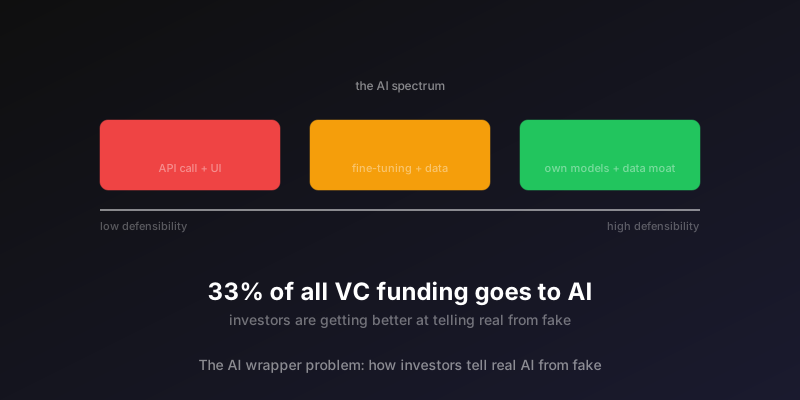
AI startups now attract 33% of total VC funding. Seed-stage AI companies receive valuations roughly 42% higher than non-AI peers. That premium creates an obvious incentive: slap "AI-powered" on your landing page and ride the wave. Investors know this. They have been watching it happen for over a year. And they have gotten very good at telling the difference between a company that built something real and a company that added an OpenAI API call to a CRUD app.
The term for the latter is "AI wrapper." If you are building one, that is not automatically a problem. But if you are pitching one as proprietary technology, that is.
What investors actually check
The scrutiny has shifted. Early in the AI boom, saying "we use machine learning" was enough to get a meeting. Now investors run what amounts to a wrapper test before writing a check.
According to Crunchbase, VCs in 2026 expect to reward "real AI advantage" and punish "AI veneer on old ideas." That is not a vague sentiment. It shows up in specific due diligence questions.
Here is what investors are actually asking:
"Does the startup own the data loop, or are they renting intelligence?" This question, flagged by Pitchworx as a key investor concern, gets at the core issue. If your entire AI capability disappears when OpenAI changes their pricing or terms, you do not have a technology company. You have a distribution play with a dependency problem.
"What happens if we remove the AI layer?" If the answer is "we still have a useful product," that is actually fine. It means AI is enhancing something valuable. If the answer is "nothing works," investors want to know what exactly you built that could not be replicated by anyone else calling the same API.
"Show me the technical architecture." Technical due diligence now includes audits of proprietary datasets, model training pipelines, and red-teaming processes. Investors or their technical advisors will look at your stack. They will ask about fine-tuning, evaluation frameworks, and data pipelines. Handwaving does not survive this conversation.
And here is the part that surprises some founders: investors are using AI-driven due diligence tools themselves. They can quickly benchmark your claims against public information, technical patterns, and comparable companies. The bar for BS has risen.
The spectrum: not all wrappers are equal
The conversation is more nuanced than "wrapper bad, proprietary good." There is a spectrum, and where you sit on it determines how you should pitch.
Pure wrapper. You call a third-party API, display the result, and charge for it. Your value is convenience or a nice interface. Examples: ChatGPT frontends, basic summarization tools, simple chatbots. These are hard to fund because the moat is essentially zero. Anyone can build the same thing in a weekend.
Value-add wrapper. You use third-party AI but add meaningful layers on top. This category is gaining investor respect when the wrapper includes unique UI/UX, superior prompting, domain-specific fine-tuning, or proprietary data integration. The AI is a component, not the product. Think of it like building a restaurant: you did not grow the ingredients, but the recipe, experience, and execution are yours.
Proprietary AI. You trained your own models, built your own data pipelines, and own the intelligence layer. This is where the 10x-50x revenue multiples live, with a median of 20x-30x. Investors love this category because it creates defensibility. But most startups are not here, and pretending to be here when you are not is the fastest way to kill a deal.
Most early-stage startups fall into the value-add wrapper category. That is completely fine. The mistake is not being a wrapper. The mistake is misrepresenting where you sit on this spectrum.
How to position AI honestly in your pitch
The difference between a funded AI startup and a rejected one often comes down to positioning, not technology. Here are real examples of how framing changes everything.
Bad positioning
"Our proprietary AI engine analyzes customer data to deliver personalized recommendations."
Translation investors hear: "We call the OpenAI API and format the response."
"We built a cutting-edge machine learning platform that transforms how companies handle support."
Translation investors hear: "We added a chatbot."
"Our deep learning models process millions of data points in real-time."
Translation investors hear: "We have no idea what we are talking about technically."
Good positioning
"We use GPT-4 for natural language processing, but our value is the proprietary dataset of 50,000 annotated customer interactions we have collected over 18 months. No one else has this data. The model gets better as our customers use it."
"Our core product is a workflow tool for compliance teams. We integrate AI to automate document review, which saves our customers 15 hours per week. The AI is a feature, not the product."
"We fine-tuned Llama on our domain-specific dataset of 200,000 legal documents. Our accuracy on contract review is 94%, compared to 71% for base GPT-4. Here is the benchmark data."
Notice the pattern. Good positioning is specific, honest about what you built versus what you bought, and focused on outcomes rather than buzzwords.
What to say when your product uses third-party APIs
Most AI startups use third-party APIs. Most funded AI startups use third-party APIs. This is not the problem founders think it is.
The problem is pretending you don't.
Here is a framework for talking about your AI stack honestly:
Name your dependencies. "We use OpenAI for language generation and Pinecone for vector search." Investors respect transparency. They use these tools too. They know what they do.
Explain your layer. What did you build on top? This is where your value lives. Maybe it is a proprietary prompt engineering framework. Maybe it is a data pipeline that feeds domain-specific context to the model. Maybe it is an evaluation system that catches errors before they reach the user. Be specific.
Show switching cost. Can you swap OpenAI for Anthropic? Can you move to an open-source model? If yes, that is a strength, not a weakness. It means your value is in your layer, not in your vendor dependency.
Quantify the improvement. "Base GPT-4 gets this task right 60% of the time. Our system gets it right 89% of the time. Here is how we measured that." Numbers beat narratives.
Be ready for the "what if" question. Investors will ask what happens if your AI provider raises prices 10x, changes terms, or shuts down. Have an answer. A good one sounds like: "We have abstracted our AI layer. Switching providers requires changing one integration module. We have already tested with three different providers."
The data moat question
If there is one question that separates fundable AI companies from unfundable ones, it is this: do you have a data moat?
A data moat means your product generates proprietary data that makes your AI better over time. Each customer interaction improves the system. Competitors cannot replicate this without building their own user base first.
Investors look for these signals:
Feedback loops. Users correct or rate AI outputs. Those corrections train better models. Better models attract more users. More users generate more corrections. This flywheel is what investors dream about.
Proprietary datasets. You have data no one else has. Maybe you collected it. Maybe your users generated it. Maybe you licensed it exclusively. The source matters less than the exclusivity.
Domain specificity. General-purpose AI is a commodity. AI trained on a specific domain with specific data for specific use cases is defensible. The more narrow and deep your data, the harder you are to replicate.
Network effects. Each new user makes the product better for all users. This is rare in AI but powerful when it exists.
If you do not have a data moat today, be honest about your plan to build one. "We are currently using third-party models, but every customer interaction feeds our evaluation dataset. By Q3, we will have enough proprietary data to fine-tune our own model." That is a credible roadmap. "We have proprietary AI" when you clearly don't is a credibility-ending statement.
A practical checklist before your next pitch
Before you present your AI startup to investors, pressure-test your positioning:
- Can you explain your AI architecture in plain language without overstating what you built?
- Do you know exactly which parts are proprietary and which are third-party?
- Can you quantify how your system outperforms using the base API alone?
- Do you have a clear answer for the data moat question, even if the answer is "we are building it"?
- Can you demo something that could not be replicated in a weekend with an API key?
- Have you tested your claims with a technical person who will push back?
If you answered no to more than two of these, you are not ready to pitch. Not because your product is bad, but because your positioning will invite the exact skepticism you want to avoid.
The 42% valuation premium for AI startups is real. But it goes to companies that can back up their claims. Investors have seen too many pitch decks with "AI-powered" in the subtitle and nothing proprietary under the hood. Be the founder who shows up with specifics, benchmarks, and honesty about where you are on the spectrum. That is more compelling than any amount of AI buzzwords.
Sources:
Enjoyed this article? Share it.