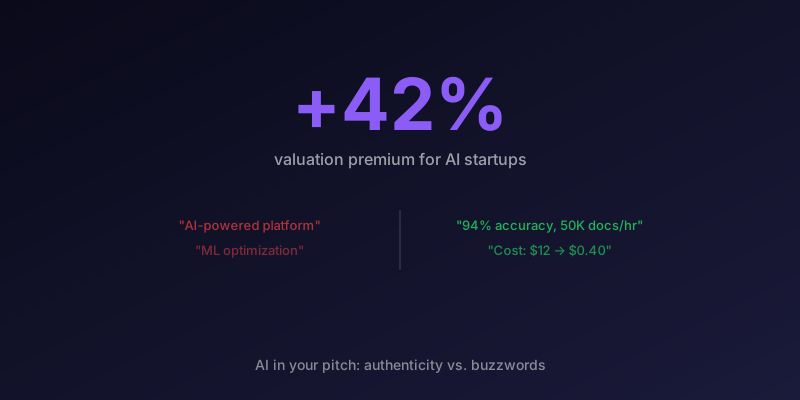
AI captured nearly 50% of all global venture funding in 2025, up from 34% the year before. Seed-stage AI companies command a 42% valuation premium over non-AI startups. The incentive to position yourself as an "AI company" is obvious.
But investors have seen through the AI hype. And the way you talk about AI in your pitch now signals more about your credibility than your technology.
The AI authenticity paradox
One investor told TechCrunch: "The more a founder says AI in the pitch, the less AI the company likely uses."
This sounds counterintuitive. If AI is your competitive advantage, shouldn't you talk about it? The answer is nuanced.
Founders who are genuinely building with AI don't need to oversell it. The technology is embedded in how they describe their product, their metrics, their differentiation. It's not the pitch. It's the foundation.
Founders who are adding "AI-powered" to their marketing because it's trendy tend to lead with the buzzword. And investors, who see hundreds of decks, have learned to spot the difference.
What "AI veneer on old ideas" looks like
VCs predict that 2026 will be a "fundamentals-first" year that rewards real AI advantage and punishes what they call "AI veneer on old ideas."
Here's what that looks like in practice:
AI veneer:
- "AI-powered analytics platform"
- "We use machine learning to optimize results"
- "Our AI understands your customers"
Genuine AI integration:
- "Our model processes 50K documents per hour with 94% accuracy, compared to 200 documents per human reviewer"
- "We fine-tuned Llama on 3 years of industry data. Benchmark performance is 23% better than GPT-4 on our specific task"
- "AI handles initial triage. Humans review edge cases. Cost per decision dropped from $12 to $0.40"
The difference: specifics. Real numbers. Clear comparisons. Honest discussion of where humans are still involved.
How to pitch AI authentically
Lead with the problem, not the technology
Your AI is the how. The problem is the why. If your pitch starts with "We built an AI that..." you're already in trouble.
Start with the problem. Make it concrete. Then explain how AI specifically enables a solution that wasn't possible before.
Bad: "We're an AI-powered recruitment platform."
Better: "Enterprise companies take 45 days to fill technical roles. Recruiters spend 60% of their time on initial screening that could be automated. We built a screening system that processes 10x more candidates with the same team."
The AI is implied. When the investor asks "How do you do that at scale?" you explain the technology.
Quantify your AI advantage
Generic AI claims get ignored. Specific performance claims get attention.
What metrics matter:
- Accuracy vs. alternatives: "Our model achieves 91% accuracy on task X. The next best approach achieves 78%."
- Speed improvement: "Processing time went from 4 hours to 3 minutes."
- Cost reduction: "We replaced a $500/hour specialist workflow with a $0.02/query API call."
- Data moat: "We've processed 50M transactions. This training data is unique to us."
If you can't quantify your AI advantage, investors will assume it doesn't exist.
Be honest about limitations
Sophisticated investors know AI has boundaries. Pretending otherwise hurts your credibility.
Discuss:
- Where your model fails (and how you handle those cases)
- What human oversight you maintain
- How you handle hallucinations or errors
- Your approach to data privacy and security
This honesty builds trust. It also shows you understand your technology deeply enough to know where it breaks.
The valuation premium is real, but earned
That 42% valuation premium for AI startups at seed stage isn't automatic. It goes to companies that demonstrate genuine AI differentiation.
Median pre-money valuations for AI startups at seed reach approximately $17.9 million. But most "AI startups" don't hit that number. The premium goes to those who can prove their AI is real, differentiated, and defensible.
Questions investors will ask:
- "What happens if OpenAI releases this feature next month?"
- "Is your model actually better, or just a wrapper?"
- "What's your data moat?"
- "How expensive is inference at scale?"
If you can't answer these confidently, you're not getting the AI premium.
Where AI belongs in your deck
Don't make AI your first slide. It signals you're leading with hype.
Do include AI in these places:
- Solution slide: Briefly mention AI enables your approach, then move on
- How it works slide: One slide explaining the technical differentiation, with metrics
- Traction slide: Show AI-specific metrics (accuracy, processing volume, cost savings)
- Moat slide: Explain your data advantage or model differentiation
Don't include:
- "AI" in your company name unless it's genuinely descriptive
- Generic AI market size stats ("The AI market will be $X trillion by 2030")
- Comparison to AGI or general AI capabilities
- Claims about your AI being "revolutionary" or "groundbreaking"
The real question investors are asking
When an investor sees AI in your deck, they're asking one question: "Is this real?"
Real means:
- You have working technology, not just a pitch
- Your AI provides measurable advantage
- Competitors can't easily replicate this with an API call
- You understand your own technology deeply
Your pitch should answer that question implicitly, through specifics and metrics, not through claims and buzzwords.
The best AI pitches barely mention AI. They show a product that works, metrics that impress, and differentiation that's obvious. The technology speaks through the results.
Enjoyed this article? Share it.