Sometimes the best fundraising strategy is to not raise at all. Here's how to know if now is the wrong time.
The default assumption is wrong
Most founders assume they should always be raising. Capital is good, more capital is better, start fundraising as early as possible.
This is wrong. Raising at the wrong time can hurt your company more than not raising at all.
Signs you shouldn't be raising right now
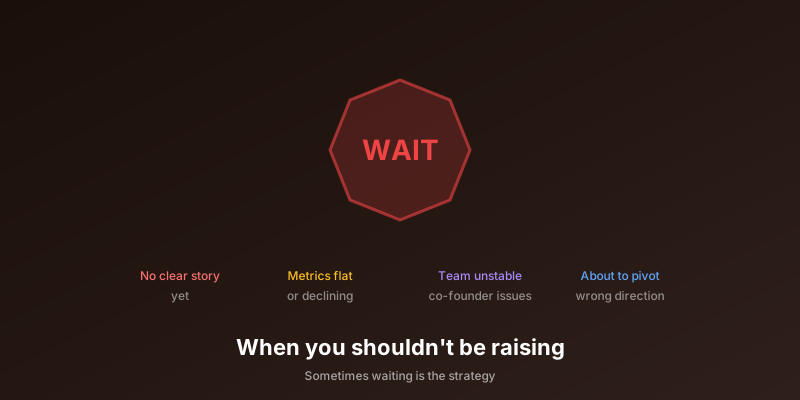
You don't have a story yet
If you can't clearly articulate:
- What you're building
- Why it matters
- Why you'll win
Then you're not ready to pitch. You'll fumble in meetings, get rejected, and burn investor relationships you'll want later.
Better to spend 2 months getting clarity than 4 months failing at fundraising.
Your traction is in a trough
If your metrics are flat or declining, now is the worst time to raise. Investors will see the trend and pass.
Better scenarios:
- Wait until you've turned the curve
- Raise when metrics are clearly improving
- Have a story for what changed
Flat metrics + "we're about to turn the corner" = no one believes you.
Improving metrics + "here's what we changed" = credible story.
Your co-founder situation is unstable
If you're in the middle of:
- Co-founder conflict
- Equity renegotiation
- Someone might be leaving
Do not start fundraising. Investors will sense the tension. They'll ask about the team. You'll either lie (bad) or reveal the instability (worse).
Sort out your co-founder situation first. Then raise.
You're going to pivot
If you're seriously considering changing direction, don't raise for the current version. You'll:
- Trap yourself in a direction you're unsure about
- Disappoint investors when you pivot
- Waste months raising for something you won't build
Figure out your direction first. Raise second.
The market is terrible for your category
Sometimes the market just isn't interested in your space. Maybe there was a high-profile failure. Maybe the sector is out of fashion. Maybe everyone's focused on AI and you're not an AI company.
Raising in a headwind is possible but painful. You'll take more meetings, get more rejections, and potentially accept worse terms.
If you have runway, consider waiting for the market to shift. Or position differently to catch current tailwinds.
You just raised
Many founders start thinking about the next round too early. You raised seed 6 months ago, you're already worried about Series A.
Investors expect 18-24 months of progress between rounds. If you're already fundraising 6 months in, it signals:
- You raised too little
- You're burning too fast
- You're not focused on building
Unless you have exceptional circumstances, build first.
The opportunity cost of fundraising
Fundraising takes time. A lot of time.
Realistic timeline:
- Preparation: 2-4 weeks
- Active fundraising: 8-12 weeks
- Legal and close: 2-4 weeks
That's 3-5 months where you're not fully focused on building. For early-stage companies, that's a long time.
If you're going to spend 4 months fundraising, it better be the right time with a high probability of success.
What to do instead
If it's not the right time to raise, focus on:
Getting to default alive. Can you cut costs enough to survive on current revenue? Having this option makes future fundraising much stronger.
Hitting a milestone. What's the one thing that would make your next raise easier? Land that customer. Hit that ARR number. Ship that feature.
Talking to customers. The best use of time when you're not raising is learning from customers. This makes everything easier later.
Building relationships. You can meet investors without actively fundraising. Coffee chats, introductions, keeping them updated. When you do raise, they'll already know you.
The cash question
The obvious counter: "But I need money."
Yes, but how much and how urgently?
If you have 6+ months of runway, you have time to improve your position before raising.
If you have less than 6 months, you may need to raise now even if conditions aren't ideal. But recognize you're negotiating from weakness.
If you have less than 3 months, you're in crisis mode. Your options are limited and your leverage is zero.
The best time to raise is when you don't desperately need to. The worst time is when you're about to run out of money.
The honest self-assessment
Ask yourself:
- If I were an investor, would I invest in this company right now?
- What's the honest answer for why someone would pass?
- Can I fix that answer in the next 3-6 months?
If you can fix your weaknesses with time and focus, consider delaying.
If the only solution to your weaknesses is capital, then you have to raise.
When you should raise
Raise when:
- You have a clear story and can tell it well
- Your metrics are trending in the right direction
- Your team is stable and committed
- You have enough runway to run a proper process (4-6 months)
- The market is receptive to your category
- You know what you'll do with the money
If all six are true, go raise. If several aren't, ask yourself whether waiting might be better.
The counter-intuitive truth
The companies that have the easiest time raising are often the ones that don't desperately need to raise.
They have options. They have traction. They're not in a hurry. Investors sense this and compete to invest.
The companies that struggle are the ones who need the money most. They're running low on runway. They're pitching from weakness. Investors sense this too.
Your goal is to get into the first category before you start your raise. Sometimes that means waiting.
Enjoyed this article? Share it.