Valuation at pre-seed and seed isn't a science. But there is math behind it. Here's how to think about it without embarrassing yourself.
The basic framework
Early-stage valuation is driven by one question: how much dilution is acceptable for this round?
Standard dilution targets:
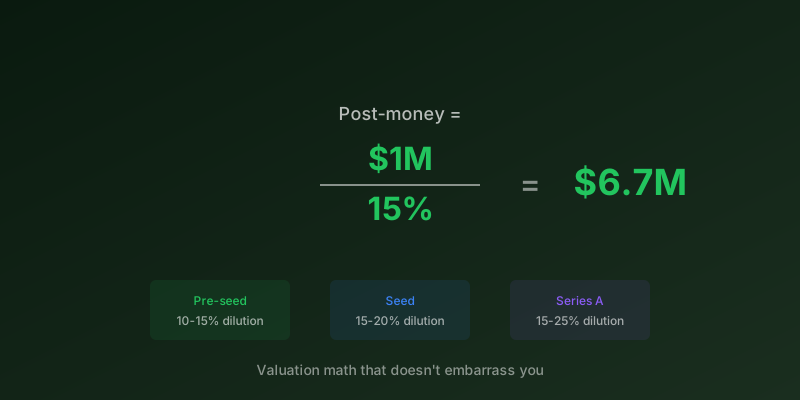
Pre-seed: 10-15% dilution Seed: 15-20% dilution Series A: 15-25% dilution
If you're raising $500K at pre-seed and targeting 12% dilution, your post-money valuation is $4.2M. That's it. That's the math.
Formula: Post-money valuation = Amount raised / Dilution percentage
$500K / 0.12 = $4.17M post-money
What determines the range
Within those ranges, where you land depends on:
Traction. More traction = higher valuation. $50K ARR company prices higher than idea-stage company.
Team. Repeat founders with exits command higher valuations. First-time founders, lower.
Market. Hot sectors (AI, climate) trade at premium. Crowded or unfashionable sectors, discount.
Competition for the deal. Multiple term sheets = higher price. One interested investor = they set the price.
The market benchmarks (2024-2026)
Pre-seed (raising $250K-$750K):
- Post-money: $3M-$6M typical
- $8M+ requires exceptional team or traction
Seed (raising $1M-$3M):
- Post-money: $8M-$15M typical
- $20M+ requires significant revenue or prior success
These numbers shift with market conditions. In 2021, valuations were 30-50% higher. Know the current environment.
How to back into your number
Start with what you need:
- How much runway do you need? 18-24 months is standard.
- What's your monthly burn? Be realistic about hiring and costs.
- What buffer do you want? Add 20% for unexpected expenses.
Example:
- Target runway: 18 months
- Monthly burn: $40K
- Total needed: $720K
- With buffer: $860K
- Round up: Raising $1M
Then apply dilution:
- Target dilution: 15%
- Post-money valuation: $1M / 0.15 = $6.7M
- Pre-money valuation: $6.7M - $1M = $5.7M
You're asking for $1M at a $5.7M pre-money valuation. That's a reasonable seed-stage ask if you have some traction.
The mistake founders make
Founders often anchor on a valuation number without understanding what it implies.
"We're raising at a $20M valuation" sounds good until you realize:
- At pre-seed, that implies exceptional circumstances
- Investors will expect Series A traction at Series A price
- You'll have trouble raising a flat or down round later if you don't hit milestones
Better to be appropriately priced and successful than overpriced and stuck.
The investor's math
Investors think about valuation differently. They're solving for return.
If a VC invests $1M at a $10M post-money, they own 10%. For that to return their fund, you need to exit at a price where 10% = meaningful multiple.
Most VCs need 10-30x returns on winners to make their fund math work. That means:
- $1M invested at $10M post-money
- Needs to grow to $100M-$300M exit value
- For their 10% to be worth $10M-$30M
If your company's realistic exit is $50M, you're not a VC-backable investment at that price. Know your exit potential.
The SAFE vs priced round question
At pre-seed, many rounds use SAFEs (Simple Agreement for Future Equity) instead of priced rounds.
SAFE with cap: You don't set a valuation now. You set a maximum valuation at which the SAFE converts in the next priced round.
Example: $500K SAFE with $6M cap. If your seed round is priced at $10M, the SAFE converts at $6M (the cap). The investor gets more ownership than seed investors paying $10M.
If seed round is priced at $5M, the SAFE converts at $5M.
The cap is the maximum, not the actual valuation.
What to say when asked
Investors will ask: "What valuation are you looking for?"
Don't say: "We're worth $15M because we'll be a billion-dollar company."
Do say: "We're raising $1M on a SAFE with a $6M cap. That's in line with other seed-stage companies with our level of traction."
Or: "We're targeting 15% dilution on this round. At $1.5M, that puts us at a $10M post-money."
Show you understand the math. Be matter-of-fact. Don't be defensive about price.
When you're overpriced
Signs you're overpriced:
- Multiple investors cite valuation as the reason they passed
- You can't find a lead
- Investors love the company but won't commit
What to do:
- Get more traction (the right solution)
- Lower your price (the fast solution)
- Find less price-sensitive investors like angels or strategic investors
What not to do: Hold firm on an overpriced round until you run out of money.
When you're underpriced
Signs you might be underpriced:
- Round fills immediately with little diligence
- Multiple investors competing to lead
- Angels are willing to pay higher than VCs
Being slightly underpriced is fine. You'll raise faster, dilute less than expected, and build goodwill with investors.
Being significantly underpriced means you're leaving money on the table. If demand is very high, it's okay to adjust terms.
The bottom line
Valuation isn't about what your company is "worth." It's about what dilution makes sense for this round, given your stage and traction.
Know the market ranges. Do the math. Be reasonable. And remember: the best valuation is one that lets you raise quickly and get back to building.
Enjoyed this article? Share it.