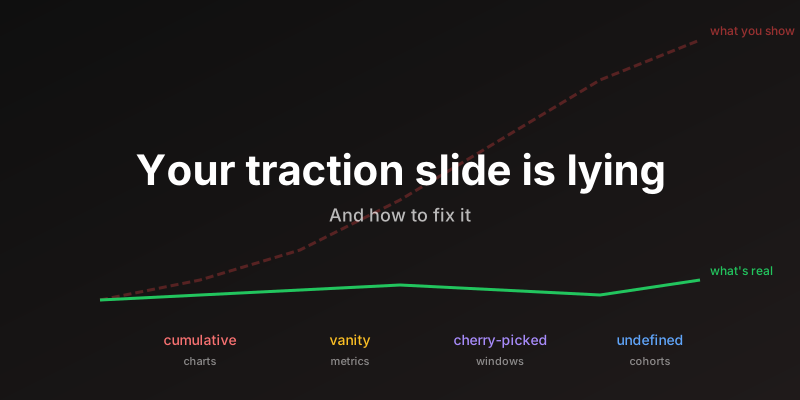
Your traction slide is probably misleading investors. Not in the way you think. Here's how to fix it.
The common lies
Most founders don't intentionally deceive. They just present traction in ways that hide the real story.
Lie #1: Cumulative charts
A graph showing "Total users over time" climbing up and to the right looks great. But it hides the truth: are you still growing, or did growth stop 6 months ago?
The fix: Show monthly active users (MAU) or monthly growth rate. Investors want to see the derivative, not the integral.
Lie #2: Vanity metrics
"50,000 downloads" means nothing without context. Downloads don't equal users. Users don't equal revenue.
The fix: Show the metric that matters for your business model:
- SaaS: MRR, ARR, net revenue retention
- Marketplace: GMV, take rate, repeat purchase rate
- Consumer: DAU/MAU ratio, Day 7/30 retention
- B2B: Pipeline value, contract value, sales cycle length
Lie #3: Cherry-picked time windows
"300% growth this quarter" sounds impressive until you realize last quarter was flat and the quarter before that was negative.
The fix: Show at least 6 months of data. Show the bad months too. Investors will find out eventually.
Lie #4: Undefined cohorts
"40% retention" is meaningless without knowing: 40% after how long? Retention of what (users? revenue? engagement)?
The fix: Show cohort curves. Week 1, Week 4, Week 8 retention. Or monthly cohorts for longer sales cycles. The shape of the curve matters more than the number.
Lie #5: "Projected" traction
A traction slide that says "We expect to reach $100K MRR by Q3" isn't traction. It's a forecast. Traction is what you've already done.
The fix: Only put actuals on the traction slide. Save projections for the financial model (if you include one).
The traction slide formula
Here's what a good traction slide includes:
For pre-revenue companies:
- User growth (with time context)
- Engagement metrics (usage frequency, session length)
- Retention curve (cohorted)
- Waitlist or demand indicators
For revenue-stage companies:
- MRR or ARR with growth rate
- Net revenue retention (for SaaS)
- Gross margin
- Customer count with average contract value
For marketplaces:
- GMV or transaction volume
- Take rate
- Repeat purchase rate
- Supply/demand balance metrics
The "so what" test
Every number on your traction slide should pass this test: if an investor asks "so what?", you should have a clear answer.
Bad example: "10,000 signups" "So what?" "..."
Good example: "10,000 signups in 3 weeks with $0 marketing spend" "So what?" "It shows organic demand. Our CAC will be significantly lower than competitors spending $50+ per signup."
What investors actually look for
1. Rate of change
Absolute numbers matter less than growth rate. $10K MRR growing 30% month-over-month is more interesting than $100K MRR growing 5%.
2. Efficiency
How much did it cost to get this traction? If you've spent $500K to acquire $10K MRR, that's a red flag. If you've spent $50K, that's interesting.
3. Quality signals
Revenue from customers who pay list price > revenue from heavy discounts. Organic users > paid users. Enterprise contracts > SMB month-to-month.
4. Sustainability
Can this growth continue? One-time PR bumps, Product Hunt launches, and influencer posts create spikes that don't compound.
The stage-appropriate traction slide
What counts as "good traction" depends entirely on your stage.
Pre-seed (raising $500K-$1.5M):
- Prototype with user feedback
- Waitlist with high intent (email > social follow)
- Design partners or LOIs
- Founding team's relevant background
Seed (raising $1.5M-$4M):
- $5K-$30K MRR (or equivalent validation)
- 3+ months of consistent growth
- Retention that suggests product-market fit
- Clear path to $1M ARR
Series A (raising $8M-$15M):
- $1M-$3M ARR
- 2-3x year-over-year growth
- Proven unit economics
- Repeatable sales process
If your traction doesn't match your stage, either adjust your ask or explain why (exceptional team, unique market timing, etc.).
The honest traction slide
The best traction slides are honest about limitations. "We're early" isn't weakness. It's appropriate for pre-seed.
What investors hate:
- Metrics that seem designed to obscure
- Claims that don't match the data
- Confidence that exceeds evidence
What investors appreciate:
- Clear metrics, clearly labeled
- Honest about what's working and what's not
- Awareness of what needs to improve
Your traction slide tells investors how you think. Show them you understand your own business.
Enjoyed this article? Share it.