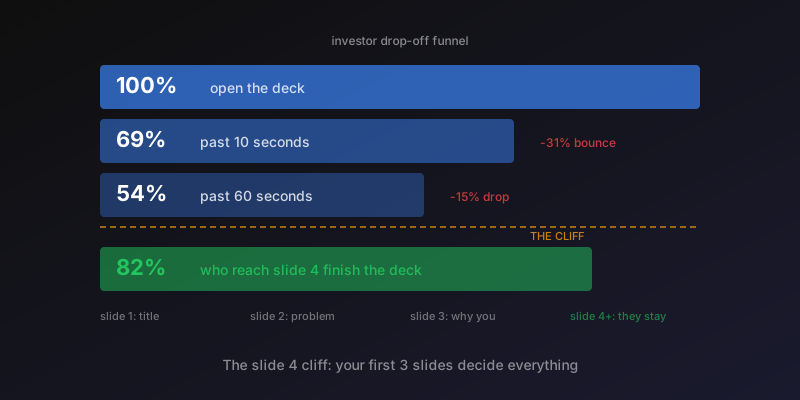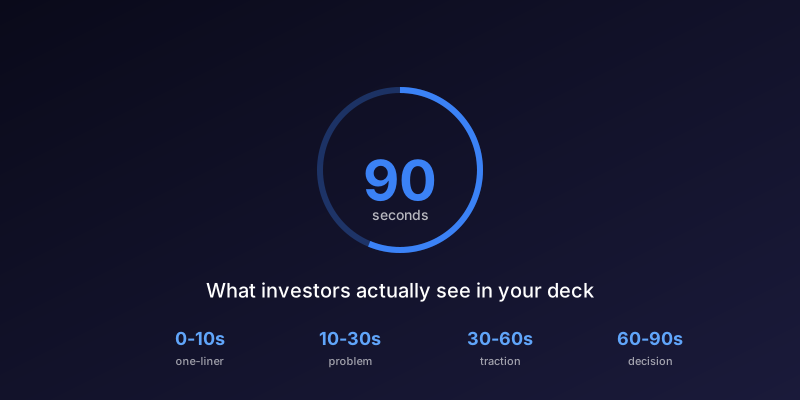
Most investors spend less than 90 seconds on your deck before deciding if they want a call. Here's what they actually see, and what they skip.
The uncomfortable truth about deck reviews
I've talked to dozens of investors about how they evaluate decks. The pattern is consistent:
- 0-10 seconds: Title slide, company name, one-liner
- 10-30 seconds: Problem and solution (if they're still interested)
- 30-60 seconds: Traction or team (depending on stage)
- 60-90 seconds: Market size, ask, maybe business model
That's it. If you haven't captured attention by then, they're on to the next email.
What gets attention
The one-liner (seconds 1-5)
This is the most important sentence in your deck. It appears on your title slide, in the email preview, and in the investor's mental model of what you do.
Good one-liners are:
- Under 50 characters
- Concrete nouns, no adjectives
- Clear on who the customer is
Bad one-liners are:
- Vague ("We're building the future of X")
- Full of buzzwords ("AI-powered platform for digital transformation")
- Missing the customer ("Revolutionary new technology")
The problem slide (seconds 10-20)
Investors scan for:
- A real problem they recognize (or can validate)
- Urgency: why now?
- Size: is this painful enough to pay for?
They skip:
- Generic market stats
- Long paragraphs
- Problems that sound theoretical
The traction slide (seconds 30-50)
This is where early-stage decks often lose investors. At pre-seed, you probably don't have revenue. That's fine. But you need something:
- Waitlist numbers with context (500 signups in 2 weeks > 5,000 over 2 years)
- User engagement (DAU/MAU, retention curves)
- Pilot customers with logos (even if unpaid)
- Design partners who've committed time
The worst thing you can do: have a traction slide that says "Launching soon."
What gets skipped
Product screenshots
Unless you have exceptional UI or viral UX, investors skip these. They're evaluating the business, not the interface. Save the demo for the call.
Detailed financial projections
Pre-seed projections are fiction. Everyone knows it. A hockey-stick chart with $50M revenue in year 5 doesn't impress anyone. Show unit economics if you have them. Otherwise, skip it.
Long competitor matrices
A slide with 15 competitors and 20 feature checkmarks is a red flag. It suggests you're competing on features, not insight. One clear positioning statement beats a cluttered matrix.
The "Why now" slide (if it's weak)
Every deck template includes this slide. Most founders fill it with generic macro trends ("AI is growing," "Remote work is here to stay"). Investors have seen these trends a thousand times. Unless your "why now" is specific and defensible, it hurts more than it helps.
The 3-slide test
If an investor only saw 3 slides, which would they be?
For most pre-seed companies:
- One-liner + problem: What are you building and why does it matter?
- Traction/validation: What evidence do you have that this works?
- Team: Why can you specifically win?
For seed and beyond:
- Traction: Revenue, growth rate, unit economics
- Market: TAM with bottom-up justification
- Ask: How much, for what milestones?
Design your deck so these slides stand alone. Everything else is supporting material.
How to use the 90 seconds
The goal of your deck isn't to close the deal. It's to get a call. Every slide should make the investor want to learn more, not feel like they've learned everything.
Practical adjustments:
- Put your best metric on the title slide
- Front-load the problem with a specific example
- Move team earlier if you have exceptional founders
- Cut any slide that doesn't directly answer: "Why should I take this call?"
You have 90 seconds. Use them to create curiosity, not to explain everything.
The real test
Send your deck to someone who doesn't know your company. Time them. Ask them to stop after 90 seconds and tell you:
- What does this company do?
- Why is it interesting?
- What would you ask on a call?
If they can't answer all three, your deck isn't ready.
Enjoyed this article? Share it.