Your one-liner is the most important sentence in your pitch. Here's how to write one that works.
Why the one-liner matters
Your one-liner appears:
- On your title slide
- In email subject lines
- In investor forwards ("You should meet this company, they do X")
- On LinkedIn, Twitter, your website
- In term sheets and legal documents
It's how people describe you when you're not in the room.
A bad one-liner creates confusion. A good one-liner creates recall. A great one-liner creates intrigue.
The anatomy of a strong one-liner
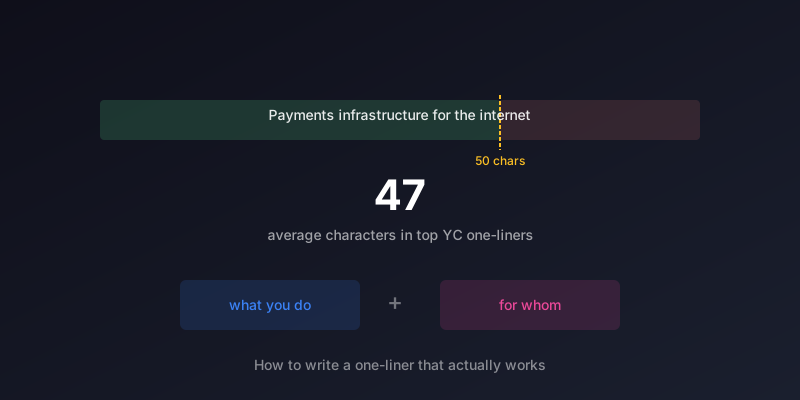
Every effective one-liner has two parts:
- What you do (the action)
- For whom (the customer)
That's it. No adjectives. No buzzwords. No "leveraging" or "revolutionizing."
Examples:
- "Payments infrastructure for the internet" (Stripe)
- "Modern payroll for startups" (Gusto)
- "Software to collect customer data" (Segment)
- "The professional network" (LinkedIn)
Notice what's missing: no "AI-powered," no "next-generation," no "world-class."
The 50-character rule
We analyzed the one-liners of YC's 91 most successful companies. Average length: 47 characters.
Short one-liners work because:
- They're memorable
- They fit in email subject lines
- They force clarity
- They're easy to repeat
If your one-liner is over 60 characters, it's probably trying to do too much.
The formula
Try this structure:
[What you do] for [specific customer]
- "Accounting software for freelancers"
- "Hiring platform for healthcare"
- "Design tools for product teams"
- "Shipping API for e-commerce"
Or this variation:
[Outcome] for [specific customer]
- "Faster code reviews for engineering teams"
- "Cheaper insurance for small businesses"
- "Better sleep for new parents"
Both formulas force you to be specific about who you serve.
Common mistakes
Mistake 1: Too vague
Bad: "We're building the future of work" Better: "Async video messaging for remote teams"
"Future of work" could mean anything. Async video messaging is concrete.
Mistake 2: Too long
Bad: "An AI-powered platform that helps enterprise companies optimize their marketing spend across multiple channels using machine learning and predictive analytics" Better: "Marketing budget optimization for enterprises"
The long version is a product description. The short version is a one-liner.
Mistake 3: Too clever
Bad: "Uber for dogs" Better: "Dog walking, on demand"
"X for Y" analogies were clever in 2012. Now they're clichés that obscure more than they reveal.
Mistake 4: Leading with technology
Bad: "AI-powered contract analysis" Better: "Contract review in minutes, not days"
Customers don't care about AI. They care about outcomes.
Mistake 5: Missing the customer
Bad: "Cloud-based inventory management" Better: "Inventory management for restaurants"
"Cloud-based" tells me nothing about who uses it. "For restaurants" tells me exactly who cares.
The test
Your one-liner passes if someone can answer these questions after hearing it:
- What does this company do? (Clear action)
- Who is this for? (Specific customer)
- Why would someone care? (Implied value)
If any answer is unclear, rewrite.
Finding your one-liner
Step 1: List what you do
Write 10 different descriptions of your company. Don't edit. Just write.
- "We help sales teams close deals faster"
- "CRM for B2B companies"
- "Sales engagement platform"
- "Email automation for SDRs"
- "Pipeline management software"
- ...
Step 2: Identify the customer
Who specifically uses your product? Not "companies" or "businesses." Who?
- Sales teams at mid-market SaaS companies
- Enterprise SDRs doing outbound
- Account executives managing complex deals
- Sales managers tracking rep performance
Pick the most specific customer you can.
Step 3: Combine and compress
Take your best action description and your most specific customer:
"Email automation for enterprise SDRs" "Pipeline management for B2B sales teams" "Deal tracking for account executives"
Step 4: Test with strangers
Share your one-liner with 5 people who don't know your company. Ask them to explain what you do back to you.
If they get it right, you're done. If they're confused, iterate.
One-liner evolution
One-liners can change as your company grows.
Early stage: Be specific to your wedge "Invoice financing for trucking companies"
Growth stage: Broaden as you expand "Working capital for logistics companies"
Scale: Claim the category "The financial platform for supply chain"
Start narrow. Expand as you earn the right.
Real examples by industry
Fintech:
- "Business banking for startups" (Mercury)
- "Expense management for teams" (Ramp)
- "Payroll that runs itself" (Gusto)
Developer tools:
- "Version control for design files" (Abstract)
- "Monitoring for microservices" (Datadog)
- "Infrastructure as code" (Terraform)
Healthcare:
- "Virtual care for employers" (Teladoc)
- "Patient scheduling for clinics" (Zocdoc)
- "Medical coding automation" (Fathom)
B2B SaaS:
- "Sales automation for outbound" (Outreach)
- "Customer success platform" (Gainsight)
- "Product analytics for teams" (Amplitude)
The final check
Read your one-liner out loud. Then answer:
- Could a competitor say the exact same thing?
- Would a customer recognize their problem in it?
- Can you say it in one breath?
If you answered no, yes, yes: you're ready.
A good one-liner won't raise your round alone. But a bad one will make everything else harder.
Enjoyed this article? Share it.