Should you show your product or stick to slides? The answer depends on what you're building, who you're pitching, and what stage you're at.
The default is deck
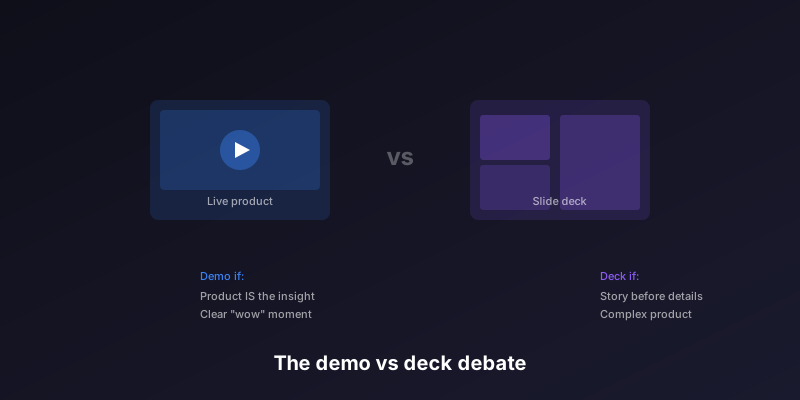
Most investor meetings should lead with narrative, not product. Here's why:
-
Story before details. Investors need to understand the problem, market, and opportunity before they care about your interface.
-
Control the pace. A deck lets you control what they see and when. A live demo invites tangents.
-
Demos break. Murphy's law applies. The one feature you need will fail in front of the one investor you need.
-
Demos take time. A 5-minute demo easily becomes 15 minutes of clicking around. That's half your meeting.
Start with the deck. Save the demo for later in the conversation, or for the second meeting.
When to demo early
There are exceptions. Demo early if:
Your product is the insight. If your differentiation is purely in the product experience (a new interaction model, a breakthrough in UX), showing beats telling.
You have a "wow" moment. If there's a single feature that makes people say "I didn't know that was possible," lead with it. Then explain why it matters.
Your market is crowded. If investors have seen 10 pitches in your space, a live demo can differentiate you from the slide decks that all look the same.
You're technical and selling to technical investors. Some investors want to see the product working. They'll ask. Be ready.
When to never demo
Don't demo if:
Your product isn't ready. A buggy demo is worse than no demo. It raises questions about execution.
You're selling enterprise software. Complex B2B products don't demo well in 5 minutes. The setup takes too long, the workflows are confusing without context, and you'll spend more time explaining than impressing.
Your product is invisible. APIs, infrastructure, and backend tools are hard to demo visually. Don't force it. Use architecture diagrams instead.
You don't know what to show. If you don't have a clear demo script that takes exactly 3 minutes, you're not ready to demo.
The hybrid approach
The best approach for most companies: deck first, demo second.
Minutes 1-15: Walk through your deck. Cover problem, solution, traction, market, team.
Minute 15: "Want to see it in action?"
Minutes 15-20: Short, scripted demo showing 2-3 key features.
Minutes 20-30: Q&A.
This structure keeps you in control while giving them something tangible.
How to demo well
If you're going to demo, do it right:
Script it. Know exactly what you're going to show and in what order. Practice until it's smooth.
Time it. Your demo should be 3-5 minutes max. Set a timer during practice.
Start logged in. Don't waste time on authentication screens or loading states.
Use real data. Fake data ("John Doe," "Acme Corp") looks amateurish. Use realistic examples.
Narrate as you go. Don't just click in silence. Explain what you're doing and why it matters.
Have a backup. If wifi fails, have a video recording ready.
What investors look for in demos
When you demo, investors are watching for:
Speed. Does the product feel fast and responsive?
Polish. Does it look professional, or does it feel like a hackathon project?
Clarity. Can they understand what's happening without explanation?
The "magic moment." Is there something that makes them lean in?
They're also watching for red flags:
Error messages. Even one "Oops, let me try that again" hurts credibility.
Confusion. If you're searching for where something is, it signals you don't know your own product.
Over-explaining. If you have to explain every click, the UX isn't intuitive enough.
The video alternative
If your product is hard to demo live, consider a pre-recorded video.
Benefits:
- No risk of live failures
- Perfectly paced
- Can show the best possible version
- Works for asynchronous review
Drawbacks:
- Less interactive
- Can't adapt to questions in real-time
- Some investors want to see it live
A 2-minute product video embedded in your deck can be more effective than a live demo for many products.
The post-demo trap
After a demo, some investors will dive deep into product questions. This can eat your entire meeting.
If this happens, redirect:
"Happy to go deeper on the product. Before we do, can I quickly cover the market opportunity and our traction?"
Don't let the demo become the whole meeting. You still need to cover the business.
The real question
The demo vs deck question is really asking: what's the best way to communicate your value?
For some companies, that's showing. For most, it's telling first, then showing to confirm.
Know which one you are. Prepare accordingly.
Enjoyed this article? Share it.