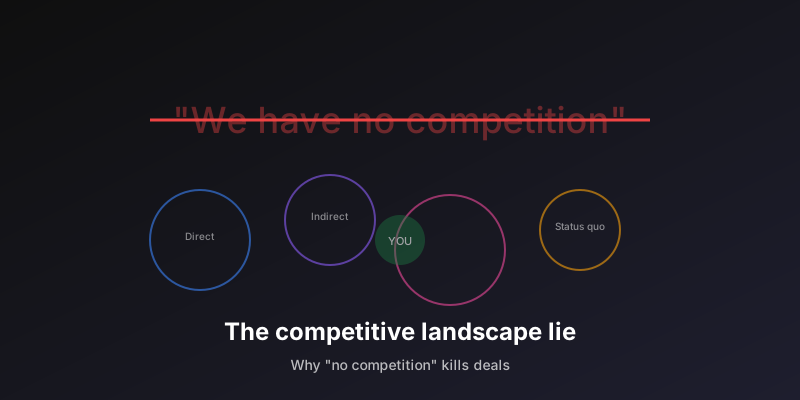
"We don't really have any competitors."
This is the fastest way to lose an investor's attention. Here's why, and what to say instead.
Why "no competition" kills deals
When founders say they have no competitors, investors hear one of three things:
-
You haven't done your research. Every problem has existing solutions, even if they're bad ones. Excel, email, and "doing it manually" are competitors.
-
The market doesn't exist. If no one else is trying to solve this problem, maybe it's not a problem worth solving. Competition validates demand.
-
You don't understand your customer. What do your customers do today? That's your competition. If you don't know, you haven't talked to enough customers.
None of these are good signals.
The competition reality
Every startup has competitors. The question is how you frame them.
Direct competitors: Companies solving the same problem for the same customer. (Figma vs. Sketch)
Indirect competitors: Companies solving the same problem differently. (Notion vs. email + docs + spreadsheets)
Status quo: How customers solve the problem today, even if it's bad. (Manual processes, spreadsheets, hiring someone)
Your slide should address all three.
The positioning mistake
Most competitive slides look like this:
| Feature | Us | Competitor A | Competitor B | |---------|-----|--------------|--------------| | Feature 1 | ✓ | ✓ | ✗ | | Feature 2 | ✓ | ✗ | ✓ | | Feature 3 | ✓ | ✗ | ✗ |
This is a feature matrix. It tells investors nothing useful.
Problems with feature matrices:
- They assume features drive purchase decisions (they often don't)
- They cherry-pick features you win on
- They reduce complex products to checkboxes
- They're easy to make and easy to dismiss
Investors have seen a thousand feature matrices. They don't differentiate.
What works instead
The positioning statement
Instead of a matrix, try a single positioning statement:
"[Competitor A] is built for enterprises with dedicated IT teams. [Competitor B] is cheap but requires heavy customization. We're the first solution designed specifically for mid-market companies who need to be live in under a week."
This is clear, memorable, and differentiating. It shows you understand the landscape and where you fit.
The JTBD approach
Frame competition around the job the customer is trying to do, not features.
"When a construction manager needs to schedule subcontractors:
- They could use Procore ($50K/year, requires training)
- They could use a spreadsheet (free, but breaks constantly)
- They could hire a coordinator ($60K/year salary)
- Or they could use us ($800/month, works on mobile, no training)"
This reframes competition around outcomes, not products.
The wedge strategy
Show where you're starting, not where you'll end up.
"Monday.com and Asana dominate project management. We're not competing with them yet. We're focused only on creative agencies, where we're 5x better than general-purpose tools because we built for their specific workflow."
The wedge strategy shows:
- You're not naive about existing players
- You have a focused entry point
- You understand how markets evolve
The magic words
Investors love hearing:
"Our unfair advantage is..." This signals you know why you'll win, not just what you're building.
"Customers switch from X because..." This shows you've talked to real customers and understand the trigger that causes them to look for alternatives.
"The gap in the market is..." This shows you've studied the landscape and found something missing.
"We don't compete on features, we compete on..." This shows strategic thinking. Maybe you compete on distribution, on pricing, on vertical expertise, on network effects.
How to research competition
Before your pitch, you should be able to answer:
-
Who are the top 3 companies customers consider? Call customers. Ask: "Before you found us, what did you consider?"
-
Why do customers choose us over them? Ask customers directly. Their words > your assumptions.
-
Why do some customers choose them over us? Understand your weaknesses. Investors will probe this.
-
What would it take for a competitor to copy us? If it's easy, that's a risk. If it's hard, explain why.
-
What's the switching cost from competitors? High switching costs = defensibility. Low switching costs = vulnerability.
The competitive slide format
Here's a format that works:
Title: How we're different
Left side: Brief landscape overview (2-3 sentences) "The contract management market has 3 types of players: enterprise suites like Icertis ($100K+ ACV), horizontal tools like DocuSign, and horizontal AI tools like Evisort."
Center: Your positioning "We're the only solution built specifically for healthcare procurement teams. We integrate with their existing systems and understand their compliance requirements."
Right side: Customer proof "That's why 8 of our first 10 customers switched from Icertis. They were paying 5x more for features they didn't need."
What to avoid
Don't: List every company in your space Do: Focus on the 2-3 that customers actually consider
Don't: Pretend you're better at everything Do: Be honest about where you win and where you're still catching up
Don't: Dismiss competitors as "legacy" or "outdated" Do: Acknowledge their strengths and explain why you'll win anyway
Don't: Show a 2x2 matrix with you in the "best" quadrant Do: (Just don't. Investors have seen this too many times.)
The confidence test
If you can't confidently answer "Why will you win?" in 30 seconds, your competitive positioning isn't clear enough.
The answer should be specific:
- "We win because we're 10x faster to implement"
- "We win because we're the only solution that integrates with X"
- "We win because we're built by the former head of Y at Z"
- "We win because we're the only ones who've figured out how to make this work for SMBs"
Competition is validation. Embrace it. Then show investors why you'll come out on top.
Enjoyed this article? Share it.