
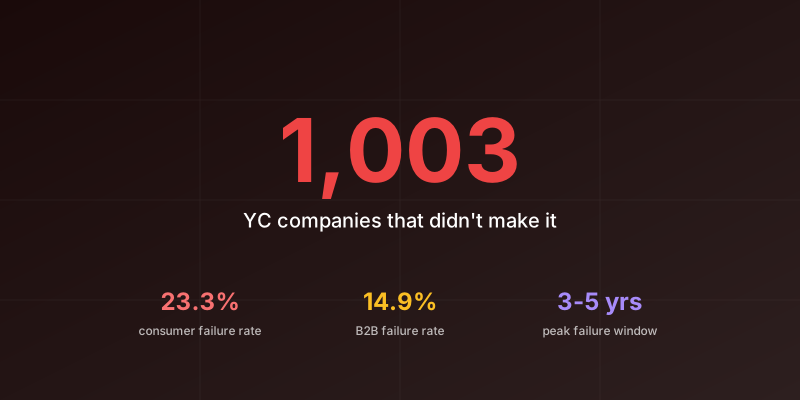
We analyzed the 1,003 Y Combinator companies that are no longer operating. Here's what the data actually says about startup failure.
The real failure rate
Of 5,662 YC companies, 17.7% are now inactive. That's 1,003 companies. The "90% of startups fail" narrative doesn't hold here. But 1,003 failures still teach us something.
The question isn't whether you'll fail. It's whether you're making the same mistakes that killed these companies.
Industry breakdown: where failure concentrates
Not all categories fail equally.
Consumer: 861 companies, 201 inactive. 23.3% failure rate.
Healthcare: 652 companies, 142 inactive. 21.8% failure rate.
Education: 210 companies, 44 inactive. 21.0% failure rate.
Fintech: 701 companies, 126 inactive. 18.0% failure rate.
B2B: 2,860 companies, 427 inactive. 14.9% failure rate.
Industrials: 235 companies, 32 inactive. 13.6% failure rate.
Consumer is the riskiest bet. Nearly 1 in 4 consumer startups shut down. The reasons are predictable: harder to monetize, higher CAC, faster trend cycles.
B2B is the safest. Only 14.9% of B2B companies failed. Revenue models are clearer, sales cycles are predictable, and enterprise contracts provide runway.
The one-liner patterns of failed companies
We compared the one-liners of failed companies versus survivors. The differences are subtle but real.
Failed company one-liners tend to:
- Be longer (avg 54 characters vs 47 for top companies)
- Use more adjectives ("revolutionary," "next-generation," "innovative")
- Focus on technology rather than outcome
- Lack a clear buyer
Examples from failed companies:
"A revolutionary platform for next-gen social experiences"
"AI-powered tools for creative professionals"
"The future of digital commerce"
What survivors do instead:
"Payments infrastructure for the internet" (Stripe)
"Modern payroll for startups" (Gusto)
"Code review for developers" (Reviewable)
The pattern: failed companies describe what they are. Survivors describe what they do for whom.
Timing: when companies die
YC companies don't fail immediately. The data shows a pattern:
- Year 1-2: 8% of eventual failures happen here (usually pivot failures or founder conflict)
- Year 3-4: 45% of failures (the "product-market fit graveyard")
- Year 5+: 47% of failures (the "scale or die" phase)
Most companies that fail do so between years 3-5. They've raised money, built product, maybe even have revenue. But they can't reach escape velocity.
The team size signal
Failed companies had an average team size of 12 employees at shutdown. Survivors average 49.
But here's the insight: the companies that failed at 20+ employees are the cautionary tales. They raised money, hired aggressively, then couldn't grow revenue to match burn.
The pattern of failure at scale:
- Raise seed round
- Hire to 15-25 people
- Miss growth targets
- Can't raise Series A
- Slow death over 6-18 months
What this means for your pitch
If you're building in consumer or healthcare, your pitch needs to acknowledge the risk. Investors know the failure rates. Show them why you're different:
- For consumer: What's your retention? What's your organic growth? Why won't you need to outspend competitors on CAC?
- For healthcare: What's your regulatory path? Who's your buyer (hospital? insurer? patient?)? What's the sales cycle?
If you're building in B2B:
- You're in the safest category, but that means more competition for attention
- Your differentiation matters more because "B2B SaaS" isn't a differentiator
The uncomfortable truth
The companies that fail often look a lot like the companies that succeed. Until they don't.
The difference usually comes down to:
- Speed of learning: Failed companies took too long to find product-market fit
- Capital efficiency: Failed companies burned too fast relative to revenue growth
- Market timing: Some ideas were right but early (or late)
YC's selection process is rigorous, yet 17.7% still fail. The best thing you can do is learn from the patterns, stay lean, and find product-market fit before you scale.
The data is clear: the longer you wait to find PMF, the more likely you join the 1,003.
Enjoyed this article? Share it.