
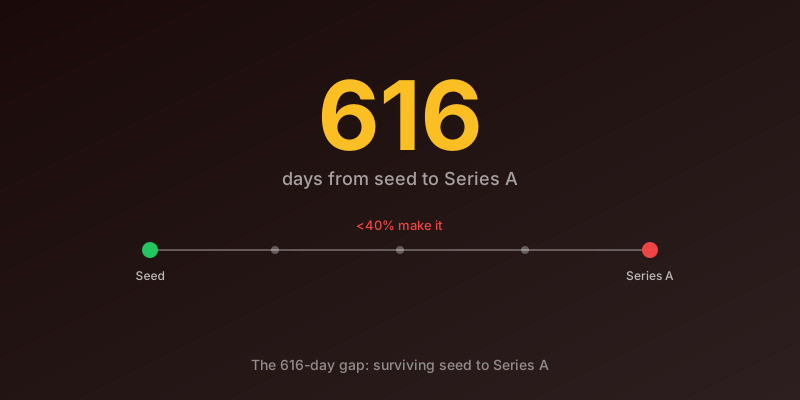
The average time between seed and Series A has stretched to 616 days. Less than 40% of seed-funded startups successfully raise a Series A. Series A deal volume dropped 18% year-over-year in 2025, with total capital down 23%.
These numbers aren't meant to discourage you. They're meant to help you plan.
The graduation rate problem
Raising a seed round used to be the hard part. Now it's table stakes. The real filter happens between seed and Series A.
What changed:
Capital concentration at later stages. Crunchbase data shows funding amounts at Series A and beyond are some of the highest ever seen. But that capital is concentrated on fewer companies. Fewer winners, bigger checks.
Higher bars for progression. In 2021, you could raise a Series A on growth alone. Now investors demand profitability metrics, retention data, and capital efficiency alongside growth.
More seed-stage companies. The number of seed rounds increased, but Series A capacity didn't scale proportionally. More companies competing for the same number of Series A slots.
What Series A investors want to see
The median Series A valuation sits at $47.9 million. For AI startups, it exceeds $50 million. To earn those valuations, investors expect specific metrics.
Revenue benchmarks
For SaaS companies, the typical Series A target is $1-2M ARR with strong growth. But the number alone isn't enough. Investors dig into the quality of that revenue:
- Net revenue retention above 100%. Existing customers should be spending more over time, not churning out.
- LTV:CAC ratio of at least 3:1. You should recover customer acquisition costs within a reasonable payback period.
- Low churn. Monthly churn above 5% is a red flag. Below 2% is excellent.
Growth metrics
Revenue matters, but so does the trajectory:
- Month-over-month growth of 15-20% is typically expected at this stage
- Consistent growth beats spiky growth. Investors want predictable trajectories, not one-time bumps.
- Cohort analysis that shows improvement. Later cohorts should retain better than earlier ones.
Unit economics
This is where many seed-stage companies fail the Series A bar:
- Gross margins above 70% for software (lower for hardware or service-heavy models)
- Clear path to profitability at scale, even if not profitable now
- CAC trending down as you optimize acquisition channels
Planning your runway for 616 days
If the average gap is 616 days, you need to plan for at least 24 months of runway from your seed round.
Here's how to think about it:
Standard seed round: $1.5-3M raised Target runway: 24 months minimum Monthly burn: $60-125K (depending on team size and location)
If you're raising $2M and burning $100K/month, you have 20 months of runway. That's cutting it close. You'll need to either:
- Raise more in your seed round
- Keep burn lower for longer
- Hit Series A metrics faster than average
Most founders underestimate how long this takes. Build buffer into your plan.
The metrics timeline
Working backwards from a Series A raise at month 20:
Months 1-6: Product development, early customers, finding product-market fit signals. Revenue is secondary to learning.
Months 7-12: Revenue focus begins. First paying customers. Building repeatable acquisition channels. You should have clear PMF signals by month 12.
Months 13-18: Scale what works. This is where ARR should accelerate. Focus on metrics that matter for Series A.
Months 19-24: Series A process. Deck updates, investor meetings, due diligence. This takes longer than most expect.
If you're not seeing PMF signals by month 12, you have a problem. Either pivot, extend runway, or accept that Series A may not happen on this path.
What to do if you're behind
Signs you're not on track for Series A:
- Month 12 and no clear path to $1M ARR
- Churn above 5% and not improving
- CAC increasing instead of decreasing
- Growth stalling after initial spike
Options:
Extend runway. Cut costs aggressively. Every month of additional runway is time to fix the business.
Raise a bridge round. Some seed investors will bridge to give you more time. This is easier than raising a new seed round and less dilutive than a down round.
Pivot. If the current approach isn't working, change it. A pivot at month 12 is better than running out of money at month 24.
Consider profitability. Some businesses are better built without venture capital. If your unit economics work at small scale, you might not need Series A.
The "fundamentals-first" era
VCs predict 2026 will reward revenue growth, efficiency, and real differentiation. It will punish growth-at-any-cost and superficial positioning.
This means your Series A pitch needs to demonstrate:
- Revenue quality, not just revenue quantity
- Efficiency metrics alongside growth metrics
- Clear path to profitability, even if distant
- Differentiation that survives scrutiny
The bar is higher. But companies that clear it have access to larger rounds than ever before. AI startups at Series A are seeing median valuations above $50M.
Building for the long gap
Practical adjustments for the 616-day reality:
Raise more than you think you need. If your plan says 18 months, raise for 24. Surprises happen.
Track Series A metrics from day one. Don't wait until month 18 to start measuring retention and LTV. Build the tracking early.
Build investor relationships before you need them. Start meeting Series A investors at month 6. Give them updates quarterly. When you're ready to raise, they should already know your story.
Have a Plan B. Know what you'll do if Series A doesn't happen. Bridge round? Profitability? Acqui-hire? Having a backup reduces desperation in negotiations.
The gap between seed and Series A is where most startups die. Plan for it, track against it, and build a company that can survive it.
Enjoyed this article? Share it.