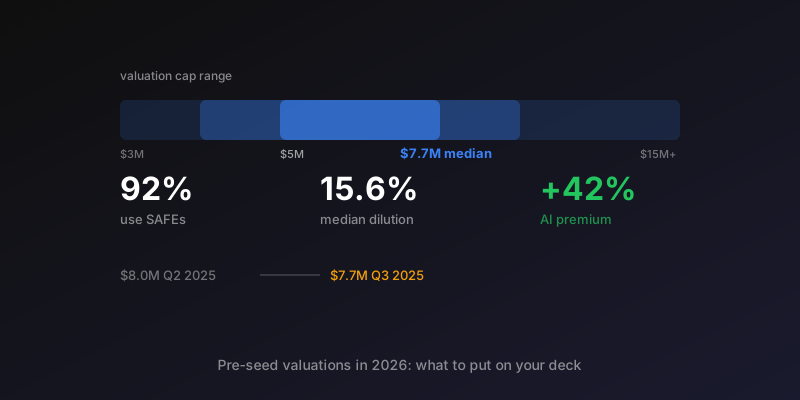
Pre-seed valuations are doing something strange right now. They're dropping slightly, but more founders are getting funded than at any point since the pandemic boom. The median pre-seed valuation fell to $7.7M in Q3 2025, down from $8.0M the quarter before. That's not a crash. It's a correction toward reality. And for founders building their first deck, it's actually a useful signal: investors are saying yes more often, but they're pricing rounds more carefully.
This post gives you the actual numbers you need to fill in your ask slide. Not theory. Not vibes. Benchmarks, ranges, and the math behind them.
The current benchmarks
Let's start with what the market actually looks like.
According to Zeni, pre-seed valuations typically range from $3M to $6M, with an average of $7M and a median of $5M. That gap between average and median tells you something important: a small number of high-profile rounds pull the average up. Most founders land closer to the median.
Carta's Q3 2025 data paints a slightly different picture because it includes SAFE cap valuations, which tend to skew higher. Their median sits at $7.7M. The difference comes down to methodology, but both sources point to the same conclusion: if you're a pre-seed founder without exceptional traction, plan for a $4M to $8M range.
Where you land in that range depends on a few things:
Your round size matters. Carta reports median valuation caps of $7.5M for rounds under $250K and $10M for rounds between $250K and $500K. Larger raises get higher caps because they typically involve more traction or stronger teams.
Your industry matters. Healthtech companies command some of the highest valuation caps, with a median of $35M for rounds of $2.5M or more. That's an outlier, driven by the capital intensity and regulatory moats in healthcare. Most sectors sit well below that.
Your dilution target matters. For founders raising $1M to $1.9M, the median expected dilution is 15.6%. Work backwards from there. If you're raising $1M and giving up 15.6%, your implied post-money valuation is about $6.4M.
How SAFEs shape your valuation
SAFEs are used in 92% of pre-seed rounds. If you're raising pre-seed, you're almost certainly using one. Understanding how they work is essential to getting your ask slide right.
A SAFE (Simple Agreement for Future Equity) isn't equity. It's a promise. The investor gives you money now, and they get shares later when you do a priced round, usually at seed. The SAFE converts at either the valuation of that priced round or the cap on the SAFE, whichever is lower for the investor.
The valuation cap is the number that matters on your deck.
What cap to set. Your cap should reflect the realistic valuation range for your stage. Carta's data gives you a framework:
- Raising under $250K: median cap of $7.5M
- Raising $250K to $500K: median cap of $10M
- Raising $500K to $1M: caps tend to range $8M to $12M
- Raising $1M or more: caps of $10M to $15M are common
Setting the cap too high creates problems later. If you set a $15M cap at pre-seed and your seed round prices at $12M, the SAFE just converts at $12M, and your early investors got no reward for taking the earliest risk. That sours relationships.
Setting the cap too low costs you equity. A $4M cap on a $500K raise means you're giving up 12.5% before your seed round even starts.
Post-money vs. pre-money SAFEs. Most SAFEs today are post-money, which means the cap includes the investment itself. This is important because it lets you calculate exact dilution. A $500K SAFE with a $5M post-money cap means the investor will own exactly 10% when it converts (assuming no discount). Pre-money SAFEs are harder to calculate because dilution depends on total money raised before conversion.
The AI premium
AI is the elephant in the room when it comes to 2026 valuations.
According to Qubit Capital, AI companies command roughly a 42% valuation premium at seed stage. Zeni reports that AI software companies have a median valuation of about $19M compared to $15M for the broader market.
That premium is real, but it comes with conditions.
When the AI premium helps:
You're building something where AI is the core product, not a feature. Your model does something that wasn't possible before. You have a defensible data advantage or a novel approach. Investors can see why this company couldn't exist two years ago.
When the AI premium hurts:
You've slapped "AI-powered" on a product that's fundamentally a workflow tool. Your pitch says "we use GPT-4" as a differentiator. Every startup in your batch has the same positioning. In this case, the AI label raises expectations without giving you anything to back them up. Investors will ask harder questions about defensibility and margins, and you'll be compared to companies with genuine technical moats.
Crunchbase reports that VCs in 2026 expect to see "revenue growth, efficiency, and real AI advantage." The emphasis on "real" is not accidental. After two years of AI hype, investors can tell the difference between genuine AI innovation and a wrapper around an API.
How to handle this on your deck: If your AI advantage is real, show it. Show the model, the data pipeline, the performance benchmarks. If AI is part of your product but not the core insight, focus on the problem you solve instead. Don't lead with AI unless it's genuinely your moat.
How to present valuation on your ask slide
Your ask slide needs to communicate three things: how much you're raising, what terms you're offering, and why the math makes sense.
The format that works:
Raising $750K on a post-money SAFE with a $6M cap
Use of funds: 18 months runway to reach seed milestones
Milestones: 100 paying customers, $15K MRR, validated pricing model
That's it. Don't over-explain. Don't put a DCF model in your appendix. Pre-seed valuation isn't about financial projections. It's about dilution math and market benchmarks.
What to say in the conversation:
Investors will push on your number. Have a simple answer ready.
"We're raising $750K on a $6M post-money cap. That's consistent with pre-seed benchmarks for our stage, and it gives us 18 months to hit seed milestones. At this cap, investors are looking at roughly 12.5% ownership."
Reference market data. Be specific about what the money buys. Show you understand that valuation is a negotiation, not a proclamation.
What not to say:
"We're worth $20M because the market is $50 billion." Investors hear this constantly and it signals that you don't understand how pre-seed pricing works.
"We're flexible on valuation." This sounds open-minded but actually signals that you haven't done your homework. Have a number. Be willing to adjust it, but start with conviction.
Anchoring with comparable raises. If you know founders at similar companies who raised recently, reference those terms (with permission). "Company X, which is at a similar stage in a similar market, closed their pre-seed at a $7M cap last quarter" is compelling because it's concrete.
Common mistakes founders make
These come up constantly. Avoiding them will save you months of frustration.
Setting the cap based on what you think you're worth
Valuation at pre-seed has almost nothing to do with intrinsic value. You probably don't have revenue. You might not have a product. The valuation is a function of how much you're raising, how much dilution is standard, and what the market will bear. Start with the dilution math, not with your ego.
Optimizing for valuation over speed
A founder spends three months trying to close at a $10M cap when investors are offering $7M. During those three months, they burn personal savings, lose momentum, and miss a market window. The $3M difference in cap translates to maybe 3-4% more dilution. That's rarely worth three months of your life.
Ignoring the signal from the market
If every investor tells you your valuation is too high, it's too high. You can argue with one investor. You can't argue with the market. Either get more traction to justify the price or lower it.
Stacking too many SAFEs at different caps
Some founders raise multiple small SAFEs at different caps over 6-12 months. This creates a messy cap table that seed investors will need to untangle. If you're going to raise on SAFEs, try to keep the terms consistent. One cap, one set of terms, one clean conversion later.
Forgetting that the cap sets expectations
A $12M cap at pre-seed means your seed round needs to price above $12M for early investors to benefit from the cap. If your seed round prices at $10M, those SAFE investors convert at $10M anyway, and they'll feel like their early bet didn't get rewarded. Set a cap that's realistic relative to where your seed round will likely price.
Not accounting for the full dilution picture
Your pre-seed SAFE isn't the only dilution event. You'll also have a seed round, maybe a bridge, an option pool expansion, and more SAFEs from advisors or angels. A 12% SAFE today plus a 20% seed round plus a 10% option pool means founders can end up below 60% before Series A. Map out the full dilution path before you set your pre-seed terms.
Putting it together
The pre-seed market in 2026 is active. More founders are getting funded, but at tighter valuations. The median has dipped to $7.7M on Carta, and the practical range for most founders sits between $4M and $8M. SAFEs dominate, AI companies get a premium (when justified), and investors care more about efficiency than vision.
For your deck, this means:
- Pick a cap backed by data. Use the benchmarks from Carta and Zeni to anchor your number. If you're raising $500K with no traction, a $5M to $7M cap is reasonable.
- Show the dilution math. Investors respect founders who understand what they're giving up and why.
- Be specific about milestones. The money buys runway to achieve something concrete. Say what it is.
- Don't chase the AI premium unless you've earned it. If your product is genuinely AI-native, say so. If not, focus on the problem.
The best pre-seed raises close quickly because the terms are fair and the founder is prepared. Know your numbers. Price reasonably. Get back to building.
Sources
Enjoyed this article? Share it.