
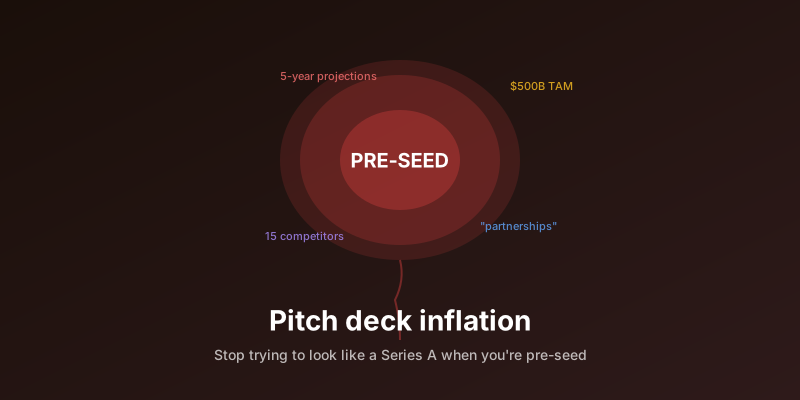
You're raising pre-seed money but your deck looks like you're pitching Sequoia for a Series B. That's a problem.
The inflation trap
First-time founders constantly build decks that would be appropriate for a company 3 years further along. They think it makes them look professional. It makes them look naive.
Signs of pitch deck inflation:
- 5-year revenue projections with specific numbers
- Detailed org charts for a 3-person team
- "Partnerships" with companies who gave you a logo
- Market size slides citing $500B TAM
- Competitive matrices with 15+ players
- Go-to-market strategies with 6 different channels
Investors see through this immediately. Now they're wondering: does this founder understand what stage they're at?
Why it backfires
It raises the wrong questions
If your deck shows $50M ARR projections for year 5, the investor starts thinking about what it would take to get there. Then they notice you have zero customers. The gap between the deck and reality creates doubt.
It signals inexperience
Experienced founders know that early-stage decks are about de-risking, not impressing. They focus on: Is this team credible? Is this problem real? Is there early signal?
Over-polished decks suggest the founder spent more time on slides than on customers.
It obscures what matters
A dense competitive matrix with checkmarks distracts from the one thing that matters: your unique insight. A simple positioning statement is more powerful.
What pre-seed actually requires
At pre-seed, you're selling potential, not proof. The bar is lower than you think.
Team (mandatory):
- Why are you the right people to solve this?
- Relevant experience or unfair advantage
- Commitment (are you full-time? leaving a job?)
Problem (mandatory):
- A problem you've observed directly
- Ideally, a problem you've experienced yourself
- Clear enough that an outsider can understand it
Solution (sketched):
- What you're building (not how it works)
- Why it's different from alternatives
- Early mockups or MVP if you have them
Validation (any signal):
- Customer conversations
- Waitlist or interest
- Design partners
- Letters of intent
Ask (honest):
- How much you're raising
- What you'll do with it
- What milestones you'll hit
That's it. You don't need market size analysis. You don't need financial projections. You don't need competitive matrices.
Stage-appropriate decks
What investors expect at each stage:
Pre-seed ($500K-$1.5M)
- 8-10 slides
- Heavy on problem, team, and vision
- Light on metrics (you probably don't have them)
- No projections needed
- Ask: 12-18 months runway to find product-market fit
Seed ($1.5M-$4M)
- 10-12 slides
- Need to show early traction (even if small)
- Some unit economics if available
- Simple market sizing (bottom-up preferred)
- Ask: runway to reach Series A metrics
Series A ($8M-$15M)
- 12-15 slides
- Strong traction required ($1M+ ARR typical)
- Proven unit economics
- Clear path to scale
- Team expansion plan
- Ask: fuel growth, expand market
Trying to look like the next stage up doesn't help. It hurts.
The minimalist test
Try this: strip your deck to 5 slides.
- What we do (one-liner)
- The problem
- Why us
- Early signal
- The ask
Can you make a compelling case with just these? If not, the issue isn't slide count. It's clarity.
What honesty looks like
The best early-stage decks are refreshingly honest:
Instead of: "We project $50M ARR in year 5 based on capturing 2% of the $500B market"
Try: "We don't know exactly how big this will be. We know 150 companies have this problem, they pay $50K/year for bad solutions, and 12 of them told us they'd switch. That's a $7.5M opportunity just from companies we've already talked to."
Instead of: "We have strategic partnerships with Microsoft, AWS, and Salesforce"
Try: "We're in the AWS startup program and using Salesforce's free tier for CRM"
Instead of: "Our AI-powered platform leverages machine learning to deliver unprecedented insights"
Try: "We use GPT-4 to summarize customer support tickets. It saves support leads 3 hours per day."
The competitive advantage of simplicity
First-time founders think they need to compete on professionalism. They don't. They need to compete on insight.
A simple deck that clearly communicates:
- We understand a real problem
- We have a credible idea to solve it
- We're the right people to try
- We need X money to test it
...will outperform a polished 25-slide monstrosity every time.
Investors are pattern-matching for founders who understand their stage. Show them you do.
Enjoyed this article? Share it.


